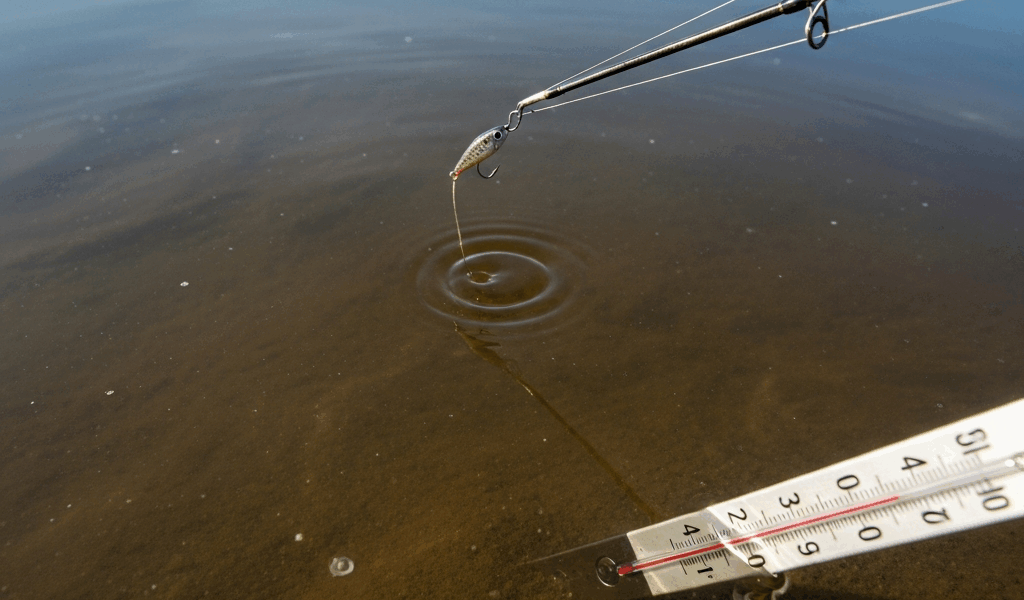
Why Bass Won’t Bite in Cold Water and How to Fix It
Cold-water bass fishing has gotten complicated with all the vague advice flying around. “Fish slower.” Great. Thanks. That tells me nothing about where the fish actually went or why my 6-inch swimbait is getting completely ignored at 7 a.m. on a 34-degree December morning. I’ve stood on enough frozen banks cursing at a dead rod to know that generic tips don’t cut it. Today, I will share everything that actually works — the diagnosis, the specific fixes, and the locations most anglers walk right past.
So, without further ado, let’s dive in.
What Cold Water Actually Does to Bass
But what is the cold-water problem, really? In essence, it’s a metabolic shutdown. But it’s much more than that.
Bass are cold-blooded. Drop the water temperature below 50°F and their feeding windows collapse. Below 40°F, they’re essentially dormant — hanging in deep water, burning as few calories as possible, ignoring anything that asks them to exert energy. A bass in 44-degree water will not chase a fast-moving crankbait. Not because it’s stubborn. Because chasing burns calories it physically cannot afford to replace. That single fact changes everything about your next three months on the water.
That’s what makes cold-water bass endearing to us anglers, honestly. They’re not gone. They’re just playing by completely different rules.
The Real Reason They Stopped Biting Today
Probably should have opened with this section, honestly. It’s the fastest way to catch an obvious mistake before you overhaul your entire setup.
Most cold-water failures trace back to three specific errors:
- Fishing too fast — You’re running lures at August speed. A bass in 48-degree water needs roughly three full seconds just to process what it’s looking at. You’re gone before it decides.
- Working the wrong depth — Cold bass abandon shallow cover. Completely. They suspend or relocate to 15-30 feet. That six-foot bank you’re casting to? They left weeks ago.
- Using summer presentations — Topwater, fast-burning crankbaits, vibrating jigs. Those worked in June. Right now they’re invisible to a fish that refuses to move more than two feet for anything.
Don’t make my mistake. I spent the first three cold-water seasons I ever fished throwing a Rapala DT-10 like it was October. Went home empty-handed every single time and blamed the lake.
Slow Everything Down — Here Is What That Actually Means
Every article says “fish slower.” None of them say what that looks like at the rod level. Let me be specific.
Jigs are your bread-and-butter presentation from November through February. A 3/16-ounce jig — not 3/8, not 1/2 — on a straight drop. Count it down. Actually count. Then pause. Hold it completely motionless for a full 8-10 seconds. This feels absurd. Do it anyway. Cold bass don’t chase. They investigate suspended baits and eventually commit. A three-second pause is a three-second window. Ten seconds is ten. I’m apparently a naturally impatient person and switching to a slow count was the single adjustment that turned my December fishing around — nothing else came close.
Finesse tackle becomes your default setup, not a backup plan. A 4-inch Yamamoto Senko-style worm on a 1/16-ounce jighead will consistently outfish a flashy 6-inch swimbait in 45-degree water. The smaller profile matches what a cold bass will actually mouth. The slow sink rate gives them processing time. I learned this the expensive way, burning half a morning throwing a $14 swimbait because I assumed bigger meant more visible.
Dead-sticking soft plastics might be the best option, as cold-water fishing requires patience most anglers flat-out refuse to give it. That is because a motionless bait in 42-degree water produces bites from fish that ignore literally everything else. Cast a stick bait on a light Carolina rig — 1/4-ounce weight, 18-inch leader, size 1 hook. Let it sit. Wait 20 seconds. Twitch it once. Wait another 20. Tedious? Yes. Effective? Absolutely.
Suspending jerkbaits deserve a mention too. A Rapala X-Rap or the Lucky Craft Pointer 100 — both suspend at rest — work because the pause IS the presentation. Twitch-twitch-pause. Hold it. Twitch-pause-pause. You’re not triggering reaction strikes in cold water. You’re creating opportunities for a sluggish fish to slowly decide yes.
Find Where Cold-Water Bass Are Actually Sitting
Location shifts completely in winter. Bass don’t leave your lake. They relocate to the least hostile environments available — and water holds heat in very specific, predictable ways.
Deep creek channels running 20-30 feet are your primary zone. Any lake with a main channel running through it will concentrate bass around that structure in winter. Not over open bottom at 25 feet — that’s a fish you’ll never reach. Tight to rock formations, stumps, or ledges along that channel. A bass on a specific rock at 22 feet is catchable. A bass suspended over featureless mud at the same depth is invisible.
South-facing banks warm faster on clear days. This sounds like a minor detail. It isn’t. A south-facing clay or rock bank at 12-15 feet will hold noticeably more active fish than a north-facing bank at identical depth. The December sun angle is low, but it still transfers heat into rock and clay faster than into shaded water. Show up at noon, not at dawn, on these banks.
Depth transitions matter more than any specific cover. Frustrated by watching bass ignore a fallen tree they’d hit all October, I started watching where they actually went. Same fish, same tree, different story — by December they’d moved to the deep edge of a nearby drop-off at 19 feet. The tree was irrelevant. The transition from 8 feet to 19 feet was everything. Your casting zone moves dramatically. You stop fishing shallow wood and start fishing the seam between shallow flats and deeper basins.
Quick Fixes to Try Right Now on the Water
You’re already out there. The bite is dead. Make these adjustments before you pull the plug:
- Drop your jig weight by half — While you won’t need to go ultralight, you will need to downsize significantly. A 3/8-ounce jig falls too fast in cold water. Switch to 3/16-ounce and count the full descent. The extended fall generates more bites than the presentation on bottom does.
- Extend your pauses to 8-10 seconds minimum — If you’re pausing three seconds between twitches, you’re rushing. Cold bass need processing time. Eight seconds feels like forever. Give it to them anyway.
- Find the nearest depth transition — First, you should locate where shallow structure drops to deep water — at least if you want to find fish after November. Cast along that edge. Work it methodically in both directions. Cold bass stage on those transitions all winter.
- Downsize your plastics immediately — A 4-inch finesse worm on a 1/16-ounce head outfishes a 6-inch swimbait in cold water. Smaller means slower sink, more time in the strike zone, more opportunity for investigation.
- Move to south-facing banks on sunny afternoons — Same lake, same species, two or three degrees warmer water. That gradient makes a real difference in December. I’m apparently someone who always arrives at first light by habit and this adjustment — just waiting until noon on south banks — changed my winter catch rate entirely.
Cold water doesn’t mean no bites. It means specific presentations in specific locations fished with specific patience. The bass are still in your lake. They’ve just relocated and slowed down, and your job is to meet them where they are — not where they were in July.

Stay in the loop
Get the latest freshwater fishing spots updates delivered to your inbox.