What Actually Happens to Trout at Midday
Midday trout fishing has gotten complicated with all the conflicting advice flying around. You’re standing in the water at 11:30 a.m., and the creek that was absolutely alive an hour ago has gone dead silent. Your strike indicator drifts through untouched. The dry fly sits on the surface for what feels like several minutes. Nothing. As someone who has burned through countless fishless midday hours on small Western streams, I learned everything there is to know about why trout vanish when the sun climbs. Today, I will share it all with you.
But what is the midday shutdown, really? In essence, it’s a biological response to temperature and light. But it’s much more than that. Trout are cold-water creatures — their metabolism, their feeding behavior, their entire nervous system runs within surprisingly narrow temperature bands. When water climbs toward 65°F, something shifts. You can check this yourself with a basic thermometer. I carry a cheap $12 Berkley digital clip-on that lives on my vest zipper. By noon in summer, especially on smaller streams, surface temps routinely creep into the high 60s or low 70s. That’s not minor. That’s meaningful.
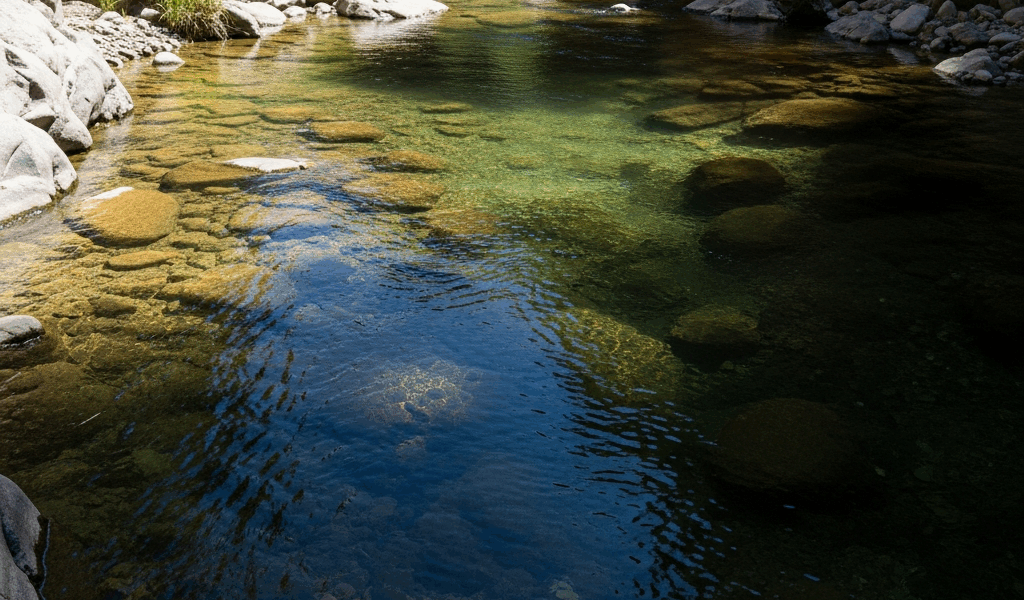
Here’s what happens below the surface: dissolved oxygen drops. Shallow water warms faster and holds less of it. Light penetration increases too — bright overhead sun means trout can see your line, your fly, your shadow with uncomfortable clarity. They become suspicious rather than aggressive. The combination pushes trout out of feeding lanes entirely. They retreat to deeper, cooler, darker water where oxygen concentrations haven’t tanked and the light isn’t giving everything away.
The trout didn’t leave your creek. They sank.
Why Your Current Presentation Stops Working
Most anglers don’t change a single thing when the bite dies. That’s the first problem — and honestly, it’s an easy trap. You fished the morning with a dry fly and lighter tippet because the water was cool and the light was low. Those choices made total sense at 7 a.m. By noon, they’re actively working against you.
Fishing the wrong depth kills more midday opportunities than anything else. If trout have dropped into the bottom third of the water column — sometimes five or six feet down in larger pools — your indicator rig riding two feet under the surface isn’t reaching them. You’re casting above their heads repeatedly. It’s not that they’re not biting. You’re just not fishing where they actually are. Big difference.
Speed is the second failure. A lethargic trout in cool water eats eagerly. A trout sitting in warm, sluggish conditions has a genuinely depressed metabolism. Fast retrieves and aggressive nymphing cadences don’t match their energy level at all. Frustrated by a four-hour skunk on the South Platte about five years ago, I slowed my retrieve to barely a crawl using a size 14 Hare’s Ear — and suddenly fish started hitting. The adjustment felt almost ridiculous at first. Like I wasn’t really doing anything. Don’t make my mistake of waiting that long to try it.
Light penetration plays a third role. Bright conditions and clear water are a genuinely bad combination. Fly choices that worked beautifully in overcast morning light become liabilities by noon. Natural, subtle presentations matter more when trout can examine your offering in detail. A size 18 olive nymph in soft light works fine. The same fly in bright sun needs to be smaller, darker, or paired with a completely different rig. That’s what makes adaptation endearing to us anglers — the problem always has a solution if you’re willing to look for it.
Three Adjustments That Bring the Bite Back
Go deeper. Switch to weighted rigs or tungsten bead-head nymphs that sink quickly and hold bottom. If you’re running a strike indicator, set it so your trailing nymph reaches the thermocline — roughly the deepest, coolest water in the pool. On a stream with 4-foot average depth, that’s often 3 to 3.5 feet. On smaller creeks, maybe 2 feet. Count-down spinners work here too. Cast upstream, let them sink for a full five seconds before retrieving. That countdown finds the depth band where trout actually live at midday.
While you won’t need a complete gear overhaul, you will need a handful of split shot or tungsten putty for extra weight. I typically pinch a 1/64-ounce bead or a small bit of putty about 18 inches above my trailing fly. The goal is bottom contact — or just above it. Not dragging aggressively. Just present and hovering.
Slow everything down. Drop your retrieve to a crawl, or switch to pure dead-drift if you’re nymphing. Dead-drift in current often outperforms any active movement during midday hours. If you fish dries or wets, extend your pause time considerably. Let the fly sit. Let the trout actually think about it. For spinners — I use them frequently during afternoon slumps — I slow the rotation until the blade barely turns. A size 2 or 3 inline spinner retrieved at half your normal speed will outfish the faster version three or four to one. Apparently I’m a slow-retrieve convert now, and Panther Martin works for me while faster presentations never really did after 11 a.m.
Downsize your offering. First, you should drop to smaller hook sizes — at least if you want to actually move fish in bright conditions. Think size 20 or 22 nymphs instead of 16s. Run thinner tippet too. In bright sun, 4X or 5X beats 3X noticeably. The reduced visibility of thinner material and the smaller profile of smaller hooks make a measurable difference when trout are being genuinely selective. This feels counterintuitive when you’re worried about break-offs, but midday trout aren’t aggressive fighters. They’re careful, deliberate, skeptical. Treat them accordingly.
Best Spots to Target When Trout Go Quiet
Not every part of the stream dies at midday. Deep pools hold temperature longer — the thermocline settles into the deepest available water. Fish these zones hard. A pool running 5 to 7 feet deep will outfish a shallow riffle by ten to one during the midday hours. That’s not an exaggeration.
Shaded undercut banks are critical too. High banks or dense tree cover blocking direct sunlight keep water temperatures lower and keep trout active. I’ve watched trout feeding steadily in shaded seams while fish sitting 20 feet away in direct sun did absolutely nothing. That’s what makes shade genuinely endearing to us midday anglers — it’s a biological refuge you can spot from the bank before you ever make a cast.
Spring-fed seams and inlet currents pull cooler water into the main stream. Find these and you’ve found a reliable pocket of trout activity even on warm afternoons. Look for subtle color changes in the water — slightly different tone often signals a cooler influx. Stand back, study the water carefully. These zones are reliable enough to justify a longer hike upstream to reach them.
On lakes and reservoirs, suspend presentations 15 to 25 feet deep — that’s where thermoclines typically establish themselves. Use sinking lines or deep drop-shot setups. The strategy differs from stream fishing but follows the same core principle: go where temperature tolerance actually exists.
When to Just Wait Them Out
Probably should have opened with this section, honestly. Sometimes the best fix isn’t a technique adjustment at all. It’s patience.
Give your adjustments 20 to 30 minutes. Try the depth changes, the slower presentation, the downsized flies. If nothing moves in that window, the honest play is to stop. Rest the water. Eat lunch. Sit on the bank with a cold drink and stop staring at the water. The evening window — roughly 5 p.m. onward — is often the best opportunity of the entire day. As water cools slightly and light angles lower, trout resume feeding with real intensity. The midday lull isn’t permanent. It’s cyclical.
So, without further ado, let’s make this practical: fish hard with adjusted tactics for 30 minutes. No results? Step back completely. Return when conditions improve. You’ll catch more trout respecting this pattern than grinding through dead water for three hours on pure stubbornness. I know because I’ve done both. One of them is significantly more fun.



Stay in the loop
Get the latest freshwater fishing spots updates delivered to your inbox.