What Summer Heat Actually Does to Walleye
Walleye fishing in summer has gotten complicated with all the conflicting advice flying around. Ask three guides why the bite dies in July and you’ll get four different answers. Here’s what’s actually happening — and why most anglers are solving the wrong problem entirely.
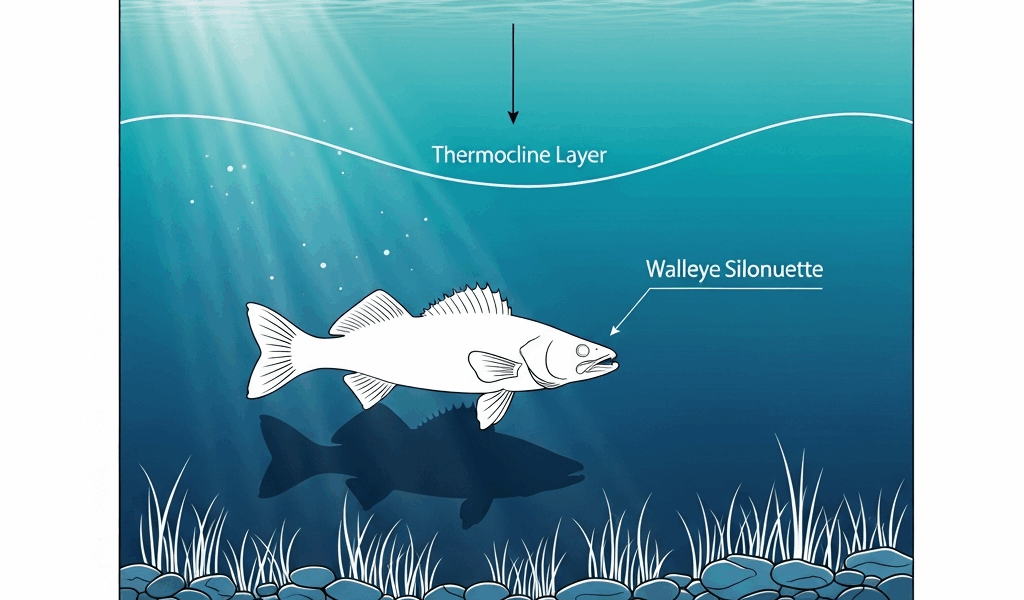
Walleye have extraordinarily light-sensitive eyes. That’s the whole thing. It’s what makes them lethal hunters at dawn and dusk, but it’s also what shuts them down when the summer sun climbs overhead. When water temps push past 70°F — and plenty of Midwest lakes hit 75–80°F by mid-July — walleye abandon the shallow flats and weed edges where they lived in May and June. They go deep. They go dark. They stack themselves just above the thermocline and basically wait out the worst of the day.
But what is the thermocline? In essence, it’s an invisible temperature boundary separating warm surface water from cold water below. But it’s much more than that. It’s essentially where walleye live in summer. Temperature drops fast there — sometimes 10–15 degrees within just a few vertical feet. Above it, the water’s warm and bright. Below it, oxygen gets thin. That narrow band just above the transition, usually sitting somewhere between 15 and 30 feet depending on your specific lake, gives them stable oxygen, cooler temps, and dim enough light that their eyes aren’t overwhelmed.
So they’re not gone. They’re not off the feed forever. They’ve just made a very logical decision about where to spend their summer, and most anglers never follow them there.
The Real Reasons They Stopped Biting
Probably should have opened with this section, honestly. Last July I spent an entire morning throwing a Rapala DT-10 at a weed line in about 8 feet of water — looked like textbook walleye structure — and came up completely empty. My buddy finally leaned over, glanced at my Humminbird Helix 7, and pointed out I was fishing the warmest water on the lake. That was a $0 lesson that cost me about four hours.
The mistakes most summer walleye anglers make come down to three things, and each one independently ruins your day:
- Wrong depth. By mid-morning, summer walleye have pushed to 15–25 feet and parked there. Fishing the 6–10 foot zone where they were crushing jigs in May is just casting practice at that point.
- Wrong time of day. The summer bite window gets brutally narrow — roughly 30 minutes before sunrise, the first couple hours after, and then again at dusk through dark. Midday is mostly a waste of fuel unless clouds roll in.
- Wrong presentation speed. Anything that moves fast enough to trigger a reaction strike in 58°F spring water will just spook a sluggish summer walleye. They want slow. Pauses. Something sitting right in front of their face without demanding they chase it.
Stack all three mistakes together and you’re staring at blank water at 2 p.m. wondering why you own a boat. That’s the summer walleye trap in one sentence.
How to Find Where They Moved
So, without further ado, let’s dive in — starting with electronics, because guessing depth in summer is genuinely just burning gas.
If you have a fish finder, the thermocline shows up as a faint horizontal band — a subtle color shift across the screen. Most modern units display it clearly enough once you know what you’re looking for. If you’re running older electronics or nothing at all, drop a basic temperature gauge — the kind that costs about $15 at any tackle shop — and record the reading every 5 feet as you lower it. When the temperature starts dropping faster than the previous intervals, you’ve found it. Write that depth down. That’s where you’re fishing.
Once you’ve located the thermocline, look for structure sitting at that same depth. Points that slope down into deep water. Rock humps topping out at 20–22 feet. Ledges. Hard bottom transitions. Summer walleye pack tight against structure — if your finder marks one fish, there are almost certainly more within casting distance. They’re not cruising; they’re stacked.
Here’s how I adjust targets through the day:
- Early morning (30 minutes before sunrise through about 8:30 a.m.): 12–18 feet, moving shallower along structure edges.
- Mid-morning through late afternoon: 18–28 feet, directly on deep structure. Don’t fight this window — fish vertically.
- Dusk onward: 15–22 feet as they migrate up to feed under low light again.
Rivers compress everything — you’re hunting deeper holes, dams, and current seams — but the thermal logic stays identical. Find the deepest shaded water, fish the edges of low-light periods, and stop expecting midday miracles.
Presentations That Actually Work in Hot Water
While you won’t need an entire retackled boat, you will need a handful of specific rigs that match what summer walleye actually want. Fast-moving crankbaits and aggressive retrieves belong in the spring box. Here’s what stays in the summer rotation.
Slow-death rig. A live night crawler on a 1/8-ounce jig head — sometimes 1/4-ounce if there’s wind — cast along bottom structure and dragged painfully slowly. Pause for 2–3 seconds between pulls. It’s not exciting to fish. It catches walleye in July when almost nothing else does. I’ve had fish inhale the crawler during the pause so subtly I almost didn’t feel it.
Drop shot with a paddle tail. A 3-inch paddle tail swimbait — I’m apparently a VMC and Berkley PowerBait guy, and natural shad colors work for me while chartreuse never seems to produce in clear water — rigged on a drop shot with 1/16 to 1/8-ounce weight. The weight hangs below the hook, which keeps your bait hovering right at thermocline depth. Work it vertically with tiny twitches. Summer walleye hit this setup hard because it’s right there at their level without demanding they chase anything.
Bottom-bouncing with a crawler harness. A light two- or three-blade harness with a fresh night crawler, trolled at 0.3–0.5 mph along structure. The blade rotation stays subtle at that speed — just enough flash to draw attention without triggering the slow-metabolism shutdown that comes with anything aggressive.
Don’t make my mistake of reaching for bright colors when the bite is slow. It feels like you’re doing something. You’re not. In clear summer water, walleye respond to natural perch patterns, subtle shad colors, and chrome — not chartreuse and fire tiger. I use white-to-chartreuse fades specifically when UV penetration is highest in the clearest water, and true natural perch patterns when there’s any stain. A $12 drop shot setup from a local shop has outfished a $40 crankbait every single July I’ve tracked it.
Best Times to Fish When Summer Bites Are Tough
That’s what makes walleye endearing to us anglers — they’re actually predictable once you understand the light-sensitivity piece. The sun is the variable. Build your fishing schedule around it.
Dawn. Start no later than 30 minutes before sunrise. This is the prime window — walleye are actively feeding as they transition from night-feeding areas back toward deeper structure. Fish the 12–20 foot zone for the first two hours, then expect the bite to fall apart somewhere around 9 a.m. as light penetration increases.
Dusk and after dark. The 30-minute window before sunset running through two hours after rivals dawn, sometimes beats it. On clear lakes, night fishing with slow presentations in 14–20 feet of water is a completely legitimate summer strategy — not a desperation move. It’s what the fish’s biology is asking you to do.
Overcast days. Cloud cover cuts light penetration dramatically. Even a midday session can produce on a solid gray sky. I’ve had walleye in 15 feet of water hitting aggressively at 11 a.m. during an overcast stretch in late July. Chase clouds when you have schedule flexibility.
First, you should adjust your expectations about the 9 a.m. to 7 p.m. window — at least if you want to fish efficiently. The fish are there. They’re sitting on structure in 18–28 feet of water. But they’re not feeding aggressively, and covering water with fast presentations is just disturbing them. A drop shot worked vertically over a mid-lake hump might coax a bite or two. Mostly though, your time is better spent off the water resting for the dusk window.
Summer walleye haven’t left. They’ve adapted — deeper depths, tighter structure, narrow feeding windows, slow presentations only. Match those three variables and the summer bite opens right back up. Miss any one of them and you’re the guy blaming the lake.

Stay in the loop
Get the latest freshwater fishing spots updates delivered to your inbox.