Why Smallmouth Bass Won’t Bite in Spring
I’ve spent enough springs on lakes with zero bites to know that frustrated feeling. You show up after a warm week, the calendar says spring, and smallmouth bass should be feeding. Instead? Radio silence. No strikes. No follows. Just that hollow feeling that you’re doing something fundamentally wrong.
Here’s the thing — it’s probably not your technique or your lures. It’s timing.
Why smallmouth bass won’t bite in spring comes down to a narrow biological window that most anglers completely miss. They’re not in pre-spawn mode anymore, but they’re not ready to hunt aggressively either. Your local thermometer will tell you infinitely more than any fishing calendar.
When Exactly Smallmouth Stop Biting in Spring
Spawning happens fast. Most smallmouth complete their spawn in roughly 7-10 days once water temps hit 55-60°F consistently. But here’s what catches people off guard: the 10 days immediately after spawn are some of the worst fishing days of the entire year.
I learned this the hard way. Mid-April, Kentucky lake, water temps sitting at 58°F. I figured I’d hit the tail end of the spawn and catch fat females guarding nests. What I found instead was absolute lockjaw. The males were burned out. The females were recovering in deep water. Nothing wanted food.
That window — roughly 48 to 72 hours after the spawn completes — is when smallmouth transition into what I call post-spawn lethargy. They’ve invested massive energy into reproduction. Their bodies are depleted. They’re not hiding anymore, but they’re also not hunting. They’re just existing in exhaustion.
This phase typically lasts 10-14 days in spring conditions. The exact timing depends entirely on your water body’s temperature progression. A lake that warms gradually from 48°F to 62°F over three weeks? Longer, slower recovery. A shallow pond that jumps from 50°F to 65°F in five days? Your window compresses significantly.
Here’s what matters: if you’re fishing during those 10 days and getting nothing, you’re not bad at fishing. You’re just timing the biological event poorly.
Why Water Temperature Matters More Than Season
Temperature is the only honest metric for smallmouth behavior in spring. The calendar lies.
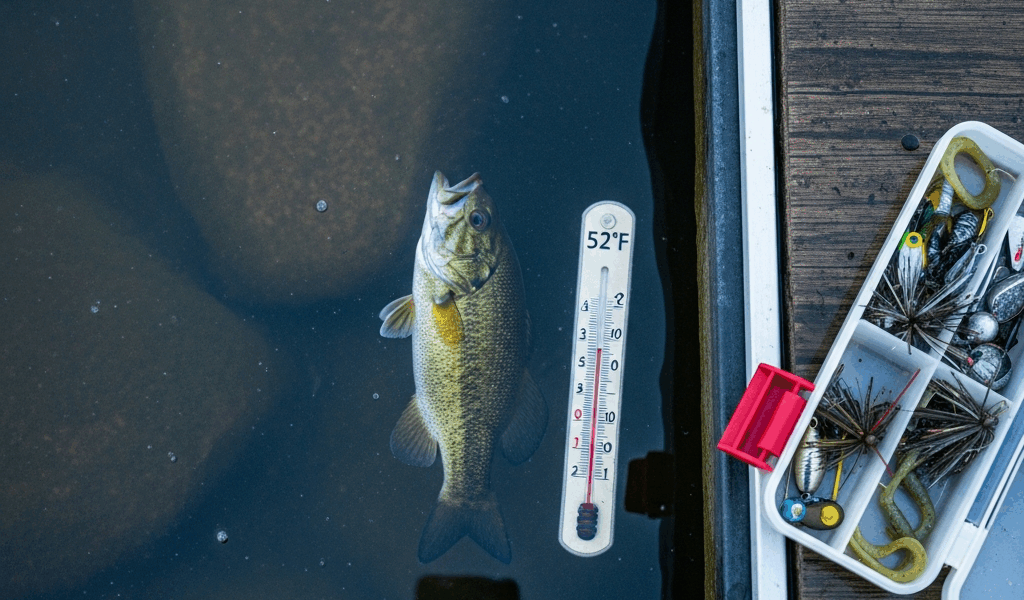
Smallmouth have a feeding trigger zone between 48°F and 58°F that feels backwards to most people. At 48-52°F, they’re barely interested in food — metabolism is slow, eating happens reluctantly. By 58-62°F, hunger kicks in and aggression returns. But that dangerous middle zone, 50-55°F? That’s where most anglers fish without understanding what they’re up against.
Pre-spawn smallmouth in the 58-62°F range are aggressive and predictable. They’re hunting to build energy reserves before reproduction. Loud crankbaits, topwater, spinner baits — they’ll chase.
Post-spawn smallmouth at 50-55°F are the opposite. Their metabolism is running on fumes. They’ll eat a meal if it swims directly into their mouth, but they won’t chase anything. They won’t commit. They’ll follow and drop it. This is what kills anglers’ confidence.
Probably should have opened with this section, honestly. A $15 thermometer from Tackle Direct changed everything about how I approach spring smallmouth. I buy the model with a 20-foot cord — lets me check temps at multiple depths. Eight feet, 12 feet, 16 feet. Temperature stratification matters in spring. You might have 52°F at 6 feet and 54°F at 15 feet. That 2-degree difference determines where fish position themselves.
Before I ever cast a line now, I check three things: water temperature at surface, water temperature at the depth where I caught fish last season, and whether that temperature falls in the aggressive zone (58°F+) or the dormant zone (48-55°F). That one habit saved me countless blank afternoons.
How to Adjust Your Lure Choice and Retrieval Speed
When water temps sit in that 50-55°F window, aggressive lures become liabilities. Crankbaits at normal retrieval speeds? Too fast. Topwater? Pointless. You’re asking exhausted fish to chase.
Switch to finesse presentations. The fish won’t commit to anything that requires effort.
Drop shot rigs work because the lure hangs nearly motionless. A 3-inch Roboworm or Senko on a drop shot rig with a 1/8-ounce weight sits where you place it. You’re not asking the fish to chase 15 feet. You’re presenting the meal six inches away. That’s it.
Tube jigs — specifically 2.5-inch models in green pumpkin or smoke — are brutally effective in post-spawn slowdowns. A 1/16-ounce jig head with an ultra-slow crawl along the bottom mimics a dying baitfish. I use the Zoom Ultravibe Speed Craw in plum because it’s $4.99 at Walmart and honestly outperforms $12 competitors.
Finesse worms work too. A straight 4-inch worm on a light Texas rig — 1/16-ounce sinker — dragged slowly across 12-16 feet of water catches fish when nothing else does. The key is speed. You want a retrieve that takes 30 seconds to move the lure 10 feet. That’s barely moving.
Color matters less than presentation during this window. Stick with natural shades: green pumpkin, watermelon, brown, black. Skip the chartreuse and white unless visibility is severely limited. Post-spawn fish aren’t looking for meals; they’re avoiding effort.
Probably the biggest mistake I made early was overthinking this. I’d throw finesse lures on fast retrieves, then wonder why fish weren’t responding. The lure wasn’t the problem. I was fishing it like the water was 65°F when it was actually 52°F. Slowness becomes your advantage in that temperature zone. Don’t make my mistake.
Fish Deeper Water (Even if It Feels Wrong)
Spring fishing intuition says shallow. Fish the 2-6 foot zone. Hunt the banks. That logic works in pre-spawn and true post-spawn. It fails during the transition window.
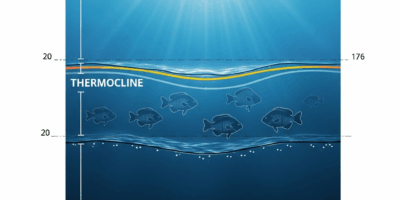
During the 10-14 day recovery phase, smallmouth migrate to 12-20 feet. Not because they’re hiding. Because the thermocline is more stable in deeper water. Temperature fluctuations at the surface can swing 3-4°F in a single day in spring. Deeper water buffers those swings. A recovering smallmouth doesn’t want instability. It wants consistency.
In clear lakes like those in the Ozarks — Table Rock, Beaver, Truman — I start in 8-15 feet of water first. Drop shot rigs on a 1/8-ounce weight get down quickly. Getting follows but no commitments? Deepen to 16-20 feet. That’s usually where the recovering females stack up.
In stained ponds or darker water bodies, the pattern shifts. Light penetration is shallower, so the stable thermocline sits in 10-14 feet instead of 15-20. Start there first.
This feels counterintuitive because you’re not catching visual spawners. No nests. No visible fish. You’re fishing structure — drop-offs, hard bottom, gravel transitions — that holds recovering fish. A depth finder becomes essential. You need to see where the bottom transitions and where fish are actually holding at 14 feet, not guessing based on sight.
The mistake I made consistently was staying shallow too long. Two hours in 4-8 feet, get nothing, then finally move deep and get three strikes in 15 minutes. Now I reverse that: check deep first. If deep is dead, then move shallow.
When Spring Smallmouth Biting Picks Back Up
Recovery is fast once it starts. The finish line is 60°F water temperature at the depth you’re fishing.
Once a consistent temperature reading hits 60°F — not a one-day spike, a sustained trend — smallmouth shift into aggressive feeding within 48-72 hours. Their metabolism accelerates. Hunger returns. Suddenly, the finesse tactics that were working become insufficient. They want volume. They want speed.
That’s when you switch back to crankbaits, topwater, and faster retrieves. A 1/4-ounce squarebill crankbait worked at normal speed will outperform a drop shot. The fish want to chase again.
The recovery window lasts roughly 2-3 weeks post-spawn. By the time most lakes hit 65°F consistently, smallmouth are in pre-summer mode: feeding aggressively, patrolling shallow water, ready for topwater at dawn.
Keep a simple log — water temps, what you caught, lure choice, depth. You’ll start seeing the pattern repeat. Water temp 48-50°F: nothing bites. 50-55°F: finesse only. 55-58°F: early bites. 58-62°F: aggressive feeding. By spring three, you won’t need to figure it out again. You’ll just show up with the right approach for the temperature zone you’re fishing.
Spring smallmouth fishing isn’t broken. Your timing just needs adjustment.


Stay in the loop
Get the latest freshwater fishing spots updates delivered to your inbox.