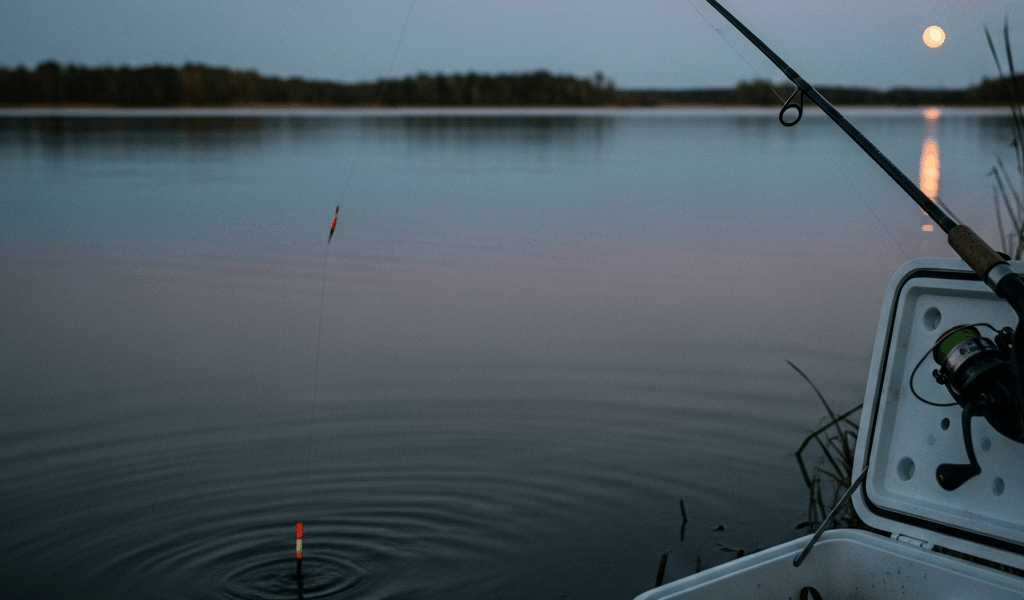
The Most Common Reason Catfish Go Quiet at Night
Night catfishing has gotten complicated with all the conflicting advice flying around. As someone who’s spent more cold, dark hours on riverbanks than I’d like to admit, I learned everything there is to know about why catfish suddenly stop biting after sunset. Today, I will share it all with you.
But what is the real culprit here? In essence, it’s water temperature dropping. But it’s much more than that — it’s about how fast it drops and what catfish actually do when it happens.
Catfish are temperature sensitive in a way most anglers underestimate. Spring and fall nights are brutal for this. Two hours after sunset, water temps can shed 3 to 7 degrees. A catfish hammering bait at 78°F turns sluggish and suspicious at 71°F. They haven’t left. They’ve just gone passive. That’s what makes temperature awareness so endearing to us catfish anglers — once you understand it, everything else starts clicking into place.
Check water temperature before you ever wet a line. Smartphone apps give you surface readings — useless for catfish. Buy a digital thermometer. The simple kind. Walmart sells one for about twelve bucks. Drop it three feet down where catfish actually cruise. If temps have fallen more than 5 degrees since sunset, you’re already fishing uphill.
Suspending is another thing catfish do during temperature shifts. Frustrated by unstable water conditions, they abandon their usual structure entirely and hang mid-column, waiting it out. This new holding behavior took me several seasons to recognize and eventually evolved into the pattern problem that catfish anglers dread and curse today — the mysteriously dead honey hole.
I learned this the hard way one October on the Wabash River. Six hours on the same sandbar. Zero bites. I figured the fish had abandoned that whole stretch. Turns out the temperature drop had pushed them into 12 to 15 feet of water, maybe a hundred yards upstream. I was stubbornly fishing 4 feet. Could’ve caught a dozen fish. Don’t make my mistake.
Check Your Bait Before You Blame the Fish
Probably should have opened with this section, honestly.
Catfish hunt by smell. Sight plays a role — sure — but once the sun disappears, scent becomes the whole game. Dead scent means no bites. Simple as that.
Here’s what most anglers completely miss: bait degrades fast in warm night air. Cut shad you hooked at 7 PM is already drying by 7:45. Those oils — the ones creating a scent trail detectable from 50 yards out — evaporate in summer heat. After 45 minutes, you’re presenting a mummified piece of meat with zero attraction. Fresh-cut shad smells sharp and alive. Old bait smells like nothing. There’s genuinely no comparison.
I’m apparently particular about bait freshness — fresh-cut mullet works for me while three-day-old shrimp never produces a single hit. I’ve sat next to anglers fishing stale bait and watched my fresh-cut get strike after strike on the same water, same spot. Bait freshness accounts for maybe 40% of the “catfish won’t bite at night” problem. Most people never even consider it.
Set a phone timer. Every 20 to 30 minutes when temps are above 75°F, pull the bait off and recut it. You don’t need a whole new shad each time — just cut another chunk off the same fish. Takes thirty seconds. Fresh exposed meat immediately releases scent into the water column. Catfish detect it.
Stink bait is worse for this problem. Once it sits exposed to air on the hook, it hardens into a shell. The ammonia smell that originally attracts catfish gets trapped inside that dried crust. Refresh it every 15 minutes — or better yet, ditch stink bait at night entirely. Live bluegill or fresh-cut skipjack outperform it dramatically after dark. The scent difference is enormous. So, without further ado, fix your bait situation before anything else.
You Are Probably Fishing the Wrong Depth
Catfish don’t stay in one zone all night. They move — and that movement follows a pretty predictable schedule once you know what to look for.
Right after sunset, catfish push shallow. Aggressive feeding mode. You can catch them 3 to 6 feet out, sometimes shallower if overhanging timber or brush offers cover. This window runs roughly two hours. Maybe less.
By 10 PM, things shift. Some catfish retreat toward channel edges and drop-offs — cooler, stable water. Others tighten against structure like submerged timber, rocky ledges, root balls. The shallow bank that produced at 8 PM goes completely dead by midnight. That’s what makes depth adjustment so endearing to us serious catfish anglers — it separates the people who catch fish all night from the ones who catch fish for an hour and then complain.
Start shallow and near the bank. Cast 20 to 30 feet out, wait 10 minutes. Bites? Stay put. Nothing? Move deeper — sinker down to 10 or 12 feet, targeting a channel edge or submerged log if you can find one. Give it 15 minutes. Still quiet? Move 50 yards up or downstream. Catfish clump in specific holding areas with dead zones in between. Repositioning every 30 minutes after midnight catches fish that stubbornness simply never will.
Creek channels deserve special attention here. Deeper and cooler, they hold catfish during temperature swings consistently. Fishing a lake or large reservoir? Find the old creek channel running through the bottom — that invisible trench is where catfish stack when conditions get unstable.
How Moon Phase Affects Night Catfish Behavior
Moon phase matters more than most guides are willing to admit. But what is the actual mechanism? In essence, it’s about light penetration and how it concentrates or scatters fish. But it’s much more than that once you start fishing around it deliberately.
Full moon nights scatter catfish across a wider shallow area. Extra light penetration pushes them out of predictable spots. They wander. Single-spot bite rates drop. You’ll work harder for fewer fish from any one location — they’re simply not stacked anywhere predictably.
New moon nights concentrate catfish. Darkness intensifies scent-based navigation. They stay tight to cover and structure. One solid honey hole can produce steady action from 9 PM until well past 2 AM. That was one of the most useful things I’ve ever learned on the water. That was 2014, Pickwick Lake, and it changed how I plan every single night fishing trip.
Don’t fight the moon. Full moon night? Accept the lower bite rate, plan to cover water, keep moving. New moon night? Find one productive piece of structure and milk it. Adjust your expectations to match reality instead of sitting confused wondering why the spot that crushed it last week is dead tonight.
Quick Fixes to Try Right Now If Nothing Is Working
- Switch to a lighter sinker. Heavy weights create drag and resistance catfish feel immediately — and then they drop the bait. A 1-ounce sinker instead of a 3-ounce egg weight makes a measurable difference. Use just enough to reach your target depth. Nothing more.
- Move 50 yards upstream or downstream. You might be sitting in a dead zone between two productive areas. Current flows differently 50 yards away. So does scent dispersal from your bait.
- Try a smaller hook with chicken liver. Been throwing large cut bait on a 5/0 or 6/0? Go down to a 2/0 or 3/0 with a walnut-sized chunk of chicken liver. Different scent profile entirely. Sometimes that’s all it takes to trigger bites that fresh-cut shad couldn’t produce.
- Add a small float. Keep bait suspended 2 to 3 feet above the silt bottom instead of dragging through muck. Catfish sometimes refuse bottom-dragging bait flat out. A small foam float keeps the presentation in the water column where scent spreads properly.
- Adjust your temperature expectations. Below 68°F, catfish slow down considerably — at least if you’re targeting channel cats or blues. Your productive window shrinks to the first two hours after sunset and the hour before sunrise. Middle of the night often produces absolutely nothing in cold water. That’s not a fixable problem. That’s just reality.
Sometimes the bite is genuinely off. Weather fronts moving through, barometric pressure crashing, spawning cycles shutting everything down — these are real factors that kill catfish activity for a day or two regardless of what you do. Repositioning beats stubbornness every time, but even perfect positioning doesn’t rescue a bad bite window. Knowing the difference between a fixable problem and a genuine off night — that’s honestly the whole skill.



Stay in the loop
Get the latest freshwater fishing spots updates delivered to your inbox.