Why Bluegill Stop Biting in Summer Heat — and How to Fix It
Summer bluegill fishing has gotten complicated with all the bad advice flying around. Cast to the dock. Use a nightcrawler. Fish the shallows. I followed that playbook for three straight Julys and came home with nothing. As someone who has been fishing bluegill since age six — dragging a Zebco 33 off my grandfather’s aluminum dock in central Wisconsin — I learned everything there is to know about why these fish disappear when the heat rolls in. Today, I will share it all with you.
Here’s the short version: bluegill don’t stop biting in summer heat. They move. Figure out where they go, and dinner fixes itself.
What Actually Happens to Bluegill When It Gets Hot
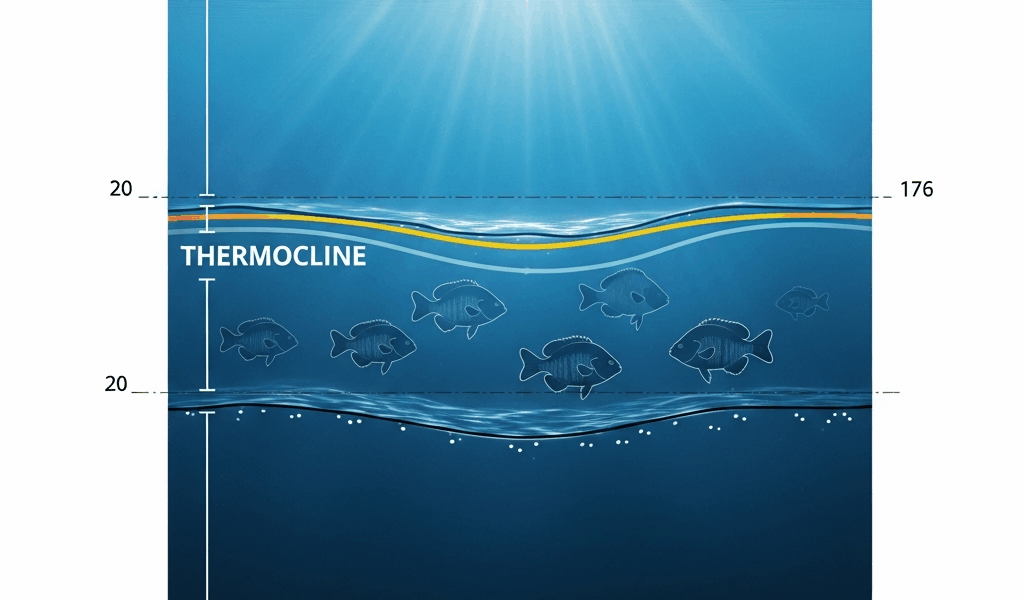
But what is thermal stratification, really? In essence, it’s what happens when summer sun heats your lake unevenly from top to bottom. But it’s much more than that — it’s the entire reason your May honey hole becomes a ghost town by July 4th.
Hot water rises. Cool water sinks. Simple physics, brutal consequences for anglers who don’t account for it. The surface layer bakes. Below that sits a band called the thermocline — temperature drops fast through this zone, sometimes five degrees in two feet. Below the thermocline, water stays cold and oxygen-starved. Bluegill hate both extremes. They won’t sit in 90-degree shallows. They won’t sit in oxygen-poor depths either.
So they pack into the thermocline band. That middle zone — usually sitting between 68 and 78 degrees — is where usable dissolved oxygen lives. It’s where the harsh midday sun can’t quite reach. It’s where every bluegill in your lake spends its summer.
Early season, the whole water column runs roughly uniform. Bluegill roam freely at three feet. July changes everything. They want depth. Structure. Shade. Darkness, essentially.
Probably should have opened with this section, honestly. The thermocline concept unlocks every fix below it.
The Depth Mistake Most Anglers Make in July and August
Ninety percent of recreational anglers fish the same depth in August as they do in April. Dock edges. Shallow weed lines. First ten feet off shore. In May, that’s productive. In July, you’re dragging bait through a dead zone.
Summer bluegill live in eight to sixteen feet of water on most lakes — not extremely deep, but deep enough that most casual anglers never find them. Clear lakes push fish toward fifteen feet. Stained or darker water compresses the thermocline higher, sometimes twelve feet or less. Water clarity determines everything.
You don’t need fancy electronics to find the thermocline, though a Garmin Striker 4 runs about $100 and removes the guesswork entirely. Without electronics, pull up LakeMaster or Navily on your phone and look at depth contours. Find the drop-off — the shelf where shallow transitions to deep. The thermocline typically parks right there.
Start at ten feet. Work down to fourteen. When you catch a fish at twelve, that’s your band for the day. Fish it vertically along deep structure rather than casting back toward shore. That single adjustment — fishing vertically over the drop at twelve feet instead of casting to a dock — probably tripled my summer catch rate. Don’t make my mistake of spending three seasons casting to empty water.
Best Times of Day to Catch Bluegill in Hot Weather
Summer flips the feeding schedule completely. Spring bluegill bite well from 7 to 10 a.m. Summer bluegill? Done by nine. Sometimes earlier.
Dawn to 7:30 a.m. is your window — reliable, consistent, worth waking up for. Water temperature hasn’t peaked yet. Bluegill sit in that transition zone between their overnight depth and their midday retreat. You intercept them moving. That’s when they feed.
By 9 a.m., they’re gone. Not literally — but functionally. Fishing 10 a.m. to 4 p.m. in mid-July is genuinely rough. You can catch fish, but you’re fighting biology rather than reading it.
Evening opens a second window. 6 p.m. to sunset. Bluegill move shallower as light fades, temperature drops, and surface oxygen becomes tolerable again. Fish the last ninety minutes of daylight hard — that’s when the biggest fish of the day move.
Overcast days change the entire equation. Heavy cloud cover suppresses light penetration and holds surface temperatures down. On a cloudy Thursday with a cold front moving through, bluegill bite through noon without complaint. I’ve had solid action from 8 a.m. to 2 p.m. under full overcast in late July. That’s what makes weather awareness endearing to us bluegill anglers.
Bait and Rig Adjustments That Turn Summer Bluegill On
Your spring nightcrawler rig stops producing in summer for two reasons. Stressed fish get picky. Light-sensitive fish get cautious. You need smaller profiles, slower movement, and subtler bait. That’s the formula.
Downsize hooks from a #4 to a #8. Drop jig weight from 1/8-ounce to 1/32-ounce. Swap your split-shot setup for light tungsten — tiny beads or micro-droppers that sink slowly without telegraphing anything unnatural.
I’m apparently a wax worm guy, and Walmart’s $5.97 containers work for me while crickets never quite do in peak heat. But bait choice matters more than most anglers admit:
- Wax worms — my first choice. Compact, naturally scented, zero action required. Drop them on a small jig and let them sit. That’s the whole technique.
- Small crickets — half-sized or smaller. The legs trigger something in heat-stressed bluegill that larger baits won’t.
- Maggots — criminally underrated. Smaller than wax worms, and they work on days when nothing else moves fish. Ask your local bait shop to stock them in summer specifically.
- Berkley PowerBait Micro Craws on a 1/32-ounce head — two-inch bodies, fished slow. These saved several August afternoons I’d otherwise have written off.
Line weight matters too. Drop from 4-pound to 2-pound test in clear water. Light line transmits subtle takes that heavy monofilament completely swallows. Summer bites are soft. You won’t feel half of them on 6-pound line.
Slow your presentation by fifty percent — at least if you want consistent summer results. In May, slight twitches while reeling works fine. In July, let your bait sit on bottom for five full seconds between micro-movements. Patience is the technique.
Where to Find Bluegill Schools When They Disappear from Shore
Bluegill don’t vanish. They relocate to specific summer sanctuaries. Find the sanctuaries once, and you’ve found them every summer after.
Deep brush piles are the primary target. Submerged timber in twelve to fifteen feet of water — fallen trees, old brush piles, anything that creates shade and breaks current — stacks bluegill like nothing else. That’s where I found them after those three wasted summers. Not at the dock. At the dead cedar tree fourteen feet down near the channel edge.
Docks still produce, but differently. Summer bluegill use dock pilings as shelter — they just hang deep and underneath, not alongside in three feet of water. Boat docks sitting over eight to twelve feet of water are far more productive than shallow dock edges. Fish under the structure, not beside it.
Creek channel edges are underrated by most anglers. Old creek beds cutting through lake basins stabilize temperature and improve oxygen flow. The drop-off edge at ten to fourteen feet along a creek channel holds fish all summer. Frustrated by empty shallows one August morning, I started scanning old aerial maps using Google Earth and located a submerged creek channel I’d never fished before — found a school of hand-sized bluegill at thirteen feet within twenty minutes.
This new approach took off for me several summers later and eventually evolved into the search pattern enthusiasts know and rely on today: locate the drop-off on Google Maps, identify brush or structure along that break, fish eight to sixteen feet with light jigs and small live bait at dawn and dusk. So, without further ado — try it on your lake this week.
They’re still there. Every single one of them. They’ve just adapted to water that’s trying to stress them out. Make the same adaptations they did, and you’ll find them.


Stay in the loop
Get the latest freshwater fishing spots updates delivered to your inbox.