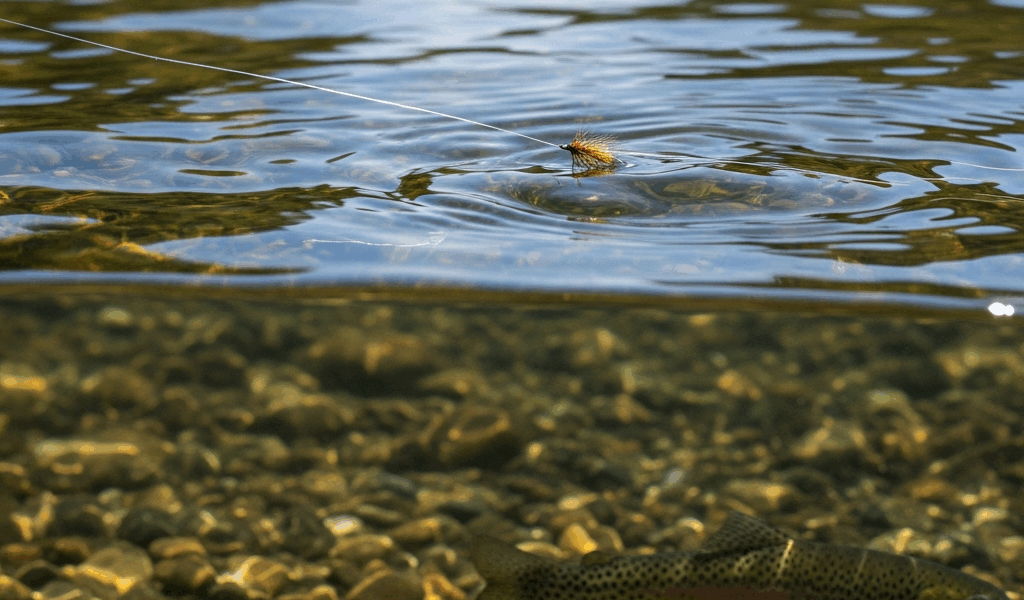
Clear Water Changes Everything for Trout
Trout fishing in clear water has gotten complicated with all the bad advice flying around. Most of it misses the actual problem entirely. Here’s the brutal truth: visibility works both ways. Standing in gin-clear water on a September morning in Colorado, I watched a 16-inch brown reject my fly three times in under two seconds. It could see my leader, my tippet knot, and probably my fraying confidence. That fish wasn’t selective — it was informed.
Murky water is forgiving. Trout hunt by lateral line and vibration, and they commit fast. Clear water is a different game entirely. A trout holding in transparent current can inspect your offering from three feet away. It can count the wraps on your knot. It will refuse a presentation that looks wrong, moves wrong, or arrives from the wrong angle — no second chances.
Most anglers blame the weather. Or moon phases. Or the guy upstream who spooked everything. The real culprit is almost always one of four things: your leader is too short or too visible, your shadow is crossing the feeding lane, you’re fishing the wrong depth, or your drift speed is off. Probably should have opened with this section, honestly — I burned two full seasons blaming “selective fish” before I figured out I was the problem the whole time.
So, without further ado, let’s dive in. The diagnostic framework I use now is simple: rule out each factor one at a time. That’s how you actually fix the bite instead of wading around confused until dark.
Your Leader Is Too Short or Too Heavy
This is mistake number one. Non-negotiable.
A short, thick leader in clear water is a neon sign that says “danger.” A 7.5-foot leader — which works fine in stained conditions — becomes a liability when the water goes transparent. Your fly looks tethered to a rope. The trout sees the whole setup and wants nothing to do with it.
For clear-water nymphing and dry-fly work, I run a minimum 9-foot leader. Better yet, go 10 or 11 feet if you’re casting to shallow, ultra-clear flats. That extra length creates distance between what the trout eats and what it can identify as unnatural. It’s not magic — it’s just geometry.
Then dial in your tippet. Fluorocarbon bends light differently than monofilament — it’s nearly invisible underwater. In clear water, I drop to 4X or 5X fluorocarbon. That’s roughly 4 to 6 pounds breaking strength depending on the brand. Rio Fluoroflex, Orvis Super Strong Plus, Maxima Ultragreen — they all perform well here. Skip the generic stuff from big-box stores. The difference between a $4 spool and a $12 spool shows up in your hookup rate when visibility is high. I’m apparently a fluorocarbon snob at this point, and Rio works for me while cheap mono never really does.
Here’s a quick test: wet a clear glass and drop in a piece of monofilament tippet and a same-diameter piece of fluorocarbon. The fluorocarbon essentially vanishes. The monofilament stays right there, visible and annoying. That’s exactly what the trout sees. Don’t make my mistake of fishing mono in clear water for two years thinking it didn’t matter.
You Are Casting Your Shadow Over the Fish
Frustrated by a pod of rising browns that wouldn’t touch anything, I once stood directly upstream of them for twenty minutes casting a technically perfect fly. Nothing. I moved fifteen feet downstream, repositioned, and caught two fish in five casts. Same fly. Same riffle. Different shadow position.
Trout face upstream — always. They’re watching current deliver food and scanning the sky for predators. Your shadow crossing their vision cone registers as a predator outline. They bolt or they lock down completely. Either way, your morning is over.
In clear water, your approach angle matters more than your presentation skill. That’s what makes clear-water fishing so endearing to us obsessive types — it rewards patience over aggression. The rule is simple: wade from downstream whenever possible. Keep your shadow off the feeding lane, even if that means awkward footing on loose rock.
Even rod flash matters. On bright days with low-angle light — think 7 a.m. in August — the flash of a fast rod stroke can spook a feeding fish at 40 feet. Slower, more deliberate casting strokes reduce that flash. Keep the rod tip lower. Use your arm, not your wrist. It feels weird at first.
From shore, crouch. Kneel if you have to. Let the treeline break your outline. A full standing profile against an open sky looks exactly like what it is — a large predator — and trout in clear water aren’t taking chances.
Wrong Depth and Drift Speed Are Killing Your Bite
But what is the “feeding window” in clear water? In essence, it’s the specific depth band where a trout is actively willing to intercept food. But it’s much more than that — in clear conditions, that window tightens dramatically. A fish in murky water might move 18 inches to eat. In clear conditions, it stays put. If your fly passes six inches above where the trout is holding, you’re fishing empty water.
First, identify the feeding depth visually. In a clear riffle, you can often see the fish directly. In a pool, look for the darkest, deepest water and start there. Watch for subtle head shows or the white flash of a trout’s mouth opening. That tells you the exact depth window — at least if you watch long enough before wading in.
Adjust your split shot accordingly. Most anglers stack all weight above the tippet. In clear water, I split it — some higher on the leader, some closer to the fly. A size 5 Storm Sighter indicator set at 18 inches, two BB shots at 12 inches above the fly — something like that. It lets your fly sink at a more natural angle and keeps it in the strike zone longer before it drags out.
Drag kills you faster in clear water than anywhere else. A slight line hesitation that goes unnoticed in stained current becomes a full alarm bell in gin-clear flow. After your fly lands, follow it with your rod tip and feed slack line continuously. If your fly moves faster or slower than the surrounding current, you have drag. Fix it immediately — mend upstream, drop your rod tip, whatever it takes.
Drift speed matters more than fly selection in clear conditions. A Hare’s Ear moving at exactly the current speed looks like food. The same fly moving a half-tick too fast looks wrong, even if the trout can’t explain why. They don’t need to explain it. They just don’t eat it.
When to Fish and When to Just Watch
Timing in clear water isn’t optional. It’s structural.
Early morning and late evening low-light windows are gold. When visibility drops, trout feed with less caution and less ability to scrutinize your rig. The 90 minutes after sunrise and the 90 minutes before sunset are when I land the most fish in clear water. That was also true in 1996 when I first started fly fishing seriously, and it hasn’t changed since.
Midday in bright sun is genuinely hard — I won’t sugarcoat it. This is when cloud cover becomes your best tool. The moment an overcast rolls in, activity spikes. Trout drop their guard noticeably. If the forecast shows cloud cover for 11 a.m. to 1 p.m., that’s your window. Set an alarm.
Otherwise, fish early and late. Use midday to scout, re-rig, or — honestly — just sit on the bank and watch the water. You’ll fish better at dawn knowing what you observed at noon. That’s not wasted time. That’s how you actually learn a piece of water.
Here’s your fast-reference checklist for clear-water diagnosis:
- Leader minimum 9 feet, fluorocarbon tippet 4–6 lb — brands like Rio or Orvis, not generic
- Shadow position — approach from downstream, keep your shadow off the feeding lane
- Feeding depth — observe before you wade in, don’t guess
- Drag-free drift — follow with rod tip, feed slack, mend immediately
- Time of day — early morning and evening win; cloud cover is a cheat code
Clear water is tough. It’s not mysterious, though. Fix these four things systematically, and the bite comes back. Every time.

Stay in the loop
Get the latest freshwater fishing spots updates delivered to your inbox.