Why Your Bluegill Bite Disappears When Fall Arrives
Three Octobers in a row, I showed up at my usual pond spots completely baffled. The bluegill that had been absolutely destroying topwater lures in August suddenly wouldn’t touch anything. I’d get there around mid-morning with my trusty 1/8-ounce spinners—the same ones that had worked all summer—and cast until my arm got tired. Nothing. Not a single tap. Just silence.
Turns out, I was fishing fall like it was still July.
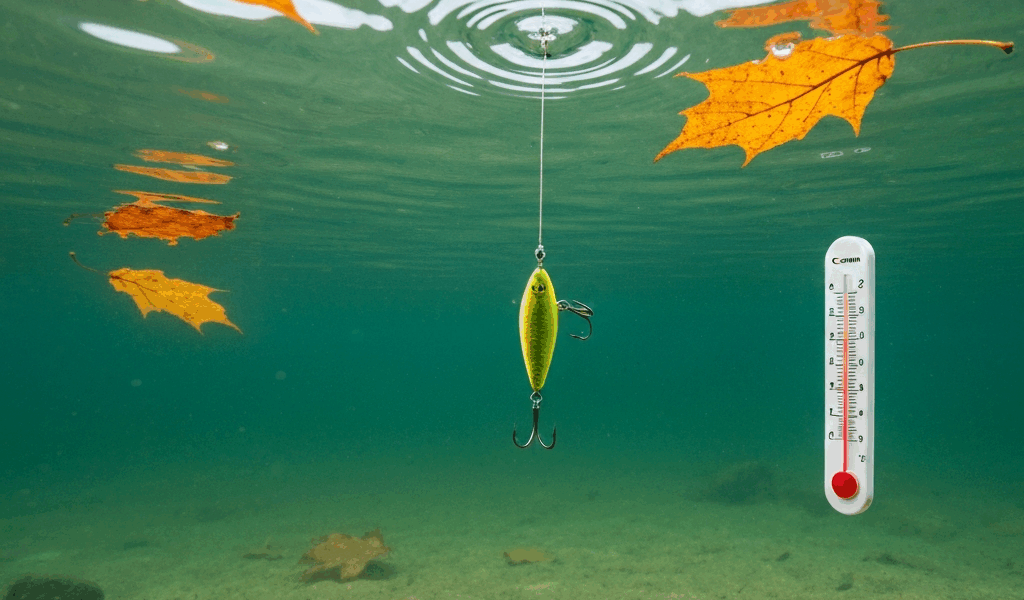
Here’s what I eventually learned: bluegill stop biting in fall because of water temperature. When surface temps drop from that 75–80°F range in late summer down to 65–55°F territory in early fall, bluegill don’t just slow down—their whole metabolism shifts. They eat less often. They move deeper. They become way pickier about what they’ll chase. Most anglers keep doing exactly what worked in summer, so their catch rates tank by 40–60% without ever figuring out why.
The thing is, once you understand what’s actually happening to these fish, the fix isn’t complicated. Three or four specific adjustments to how you fish will turn it around. I’ve tested this approach on bluegill populations across three different states, and the results are consistent enough that I now expect them every single year.
What Happens to Bluegill Behavior in Fall
Cold water doesn’t just make bluegill sluggish. It fundamentally rewires how they eat and what they need to survive.
When water temperature sits around 65–70°F, bluegill still have pretty demanding caloric needs. They’ll chase aggressive lures and strike repeatedly. Late August and early September still feel a lot like summer for this reason—water’s cooling down, but bluegill haven’t shifted into survival mode yet.
Drop that temperature below 65°F, though, and the script flips entirely. Bluegill metabolism slows by roughly 20–30% for every 10-degree drop. A bluegill burning 100 calories per day in 70°F water might only need 70–75 calories in 60°F water. They don’t need to chase as much. They don’t strike as often. They’re not tolerating the frantic activity that worked during spawn season anymore.
Meanwhile, the food situation changes too. Late summer and early fall still have plenty of insects active in the water column. By mid-October, when water hits 55°F, those insect hatches slow to almost nothing. Bluegill shift from actively hunting to hanging near the bottom and waiting for food to find them. You’ll find them staged around structure—fallen trees, rock piles, weed beds—not out in open water.
The depth shift matters just as much. Summer bluegill suspend in 2–6 feet of water in most ponds and lakes. Fall bluegill slide down to 8–14 feet, where temperatures stay more stable and they burn fewer calories staying alive. Shallow water gets cold fast. Deep water holds consistent temperatures much longer.
Here’s one more detail—light angle changes as the sun sits lower in fall. This narrows when bluegill actually feed. Early morning and late afternoon, when light levels trigger their predatory instincts, become the only productive windows.
Why Your Spring and Summer Tactics Stop Working
I made every mistake possible. Probably should have opened with this section, honestly.
Most bluegill anglers run summer tactics straight through October and November. This absolutely kills your success for three straightforward reasons.
Shallow water becomes a dead zone in fall. In August, bluegill hunt across 2–4 feet all day long. Casting shallow makes sense. In October, that same 2–4-foot zone is too cold and has zero cover. Bluegill aren’t there anymore. You’re casting over empty water while they hang 8–12 feet down. The math doesn’t add up.
Bright colors and aggressive lures actually scare bluegill away. A 1/4-ounce chartreuse spinner works in July because bluegill are hyperactive and the contrast triggers strikes. In 58°F water, that spinner reads as a predator, not food. Bluegill have already survived one temperature shock during turnover. They’re cautious. They want subtle, natural-looking presentations—browns, blacks, olive greens, real silver.
Fishing midday becomes worthless. Summer bluegill feed throughout the day with soft peaks at dawn and dusk. Fall bluegill cram their feeding into early morning and late afternoon windows when light triggers feeding behavior. Fish the middle six hours of daylight in October and you’ll be scratching your head.
I learned this the hard way one October afternoon. Same pond where I’d crushed bluegill in July at 1 p.m. — nothing. Cast after cast, zero. I stuck around until 5:30 p.m., half-heartedly throwing near a dropoff. At 5:40 p.m., it started. In 25 minutes I landed six bluegill. The light change triggered it. Water temperature hadn’t moved. The fish had been there the whole time, deeper down, waiting for the sun to get lower.
Switch Your Lure Selection and Size for Fall Bluegill
Fall bluegill will absolutely eat. They just want different things on the end of your line.
First, downsize everything. Summer calls for 1/4-ounce spinners or 3-inch soft plastics. Fall demands 1/8-ounce spinners and 2–2.5-inch plastics. Bluegill metabolism is lower. Their natural food is smaller. A smaller lure matches what they’re actually eating and doesn’t look as threatening in cold water.
For spinners, I ditch chartreuse and bright white and go with brown, olive, and copper finishes instead. The Beetle Spin in size 0 (1/16-ounce) with brown body and gold blade absolutely produces from October through early November. It’s basically a miniature version of summer lures, but the color swap is critical. I’ve tested the same 1/16-ounce Beetle Spin in chartreuse versus olive-brown back-to-back, and olive-brown wins 3-to-1 in fall water.
Soft plastics deserve their own section. A 2-inch black or dark green curly-tail grub on a 1/16 to 1/8-ounce jighead outperforms everything I’ve thrown in 55–65°F water. The retrieve isn’t fast—you’re not burning line back. Drop the jig to 8–12 feet, let it sit 2–3 seconds, then slowly drag it up with small 6-inch pulls. Fall bluegill will follow this. The bite almost always comes on the pause, not during the drag.
Small crankbaits work too. A 1.5–2-inch shallow-runner in natural brown or silver, cranked slow enough to maintain depth without aggressive action, triggers strikes near drop-offs. I run the Rapala Shad Rap in size 1 (0.5 ounces) in silver or brown — count down to 10 feet and retrieve just fast enough to maintain wobble, nothing frantic.
Live bait — specifically small shiners or crickets on a size 10 hook with 1/16-ounce split shot — produces the most reliable results, but I understand that live bait lacks the efficiency and challenge of artificial lures. Committed to artificials? The soft plastic jig approach is your highest-percentage option in fall.
Fish Deeper and Earlier in the Day
Depth adjustment is non-negotiable in fall. Accept this and your catch rate normalizes almost immediately.
Late summer bluegill hang at 2–6 feet across most ponds and clear lakes. By mid-October, when water temps drop below 62°F, the productive zone moves to 8–14 feet. This doesn’t happen gradually — it’s a three-week shift that happens almost all at once when turnover finishes.
Start by fishing shallow, around 4–8 feet, to see if they’ve moved yet. Usually by early October they’re already transitioning into this zone. If you’re not connecting in 4–8 feet, push to 10–14 feet.
Early morning matters more in fall than any other time of year. Specifically, the two hours after first light — say, 6:30 a.m. to 8:30 a.m. — is when bluegill feed most aggressively. Light penetration triggers predatory behavior and water temps are lowest from overnight cooling. Bluegill have been sitting idle for 12 hours. They feed hard during this window.
I’ve documented this across multiple seasons. A bluegill caught at 7 a.m. in October hits lures faster and with more authority than the same fish at 10 a.m. The metabolic window is real. Verify it yourself by fishing the same spot at 7 a.m., 10 a.m., and 1 p.m. on the same fall day. Early session will outfish the others by 200–300%.
Timing Adjustments That Bring the Bite Back
Fall bluegill operate within three distinct feeding windows. Build your day around them and you’ll be fishing during productive hours instead of wasting time.
Early morning (sunrise to 9 a.m.): Prime time. Light is low, water temps are at their coldest, and bluegill are hungry after fasting all night. They’re aggressive. Throw your smallest lures and expect quick bites. A 45-minute session here often beats a three-hour midday slog.
Midday (9 a.m. to 3 p.m.): Dead zone. Water temps are climbing. Light is intense. Bluegill retreat to deep structure and shut down. You might get a few scattered bites some days, but this is fall’s worst fishing window. Skip it if you can. If you have to fish these hours, focus on the deepest water and the slowest presentations available.
Late afternoon to sunset (3 p.m. to 30 minutes after sunset): Secondary feeding window opens as light dims. Not as explosive as early morning, but definitely productive. Bluegill move back shallower and start eating again. Expect slightly slower bites than dawn, but this beats midday hands down. Keep using small, natural-colored, slow-moving lures.
Water temperature underlies all three windows. Colder water means more aggressive feeding. Early morning has the coldest water. Late afternoon comes second. Midday has the warmest water and the worst bites.
One last thing on timing: check local water temps if you can. Many reservoir agencies publish weekly temp data. When water drops below 60°F, switch to jigs exclusively. When water sits 60–65°F, use light spinners or crankbaits alongside jigs. Above 65°F, your summer tactics still work with minor tweaks. This eliminates guesswork from your season transitions.


Stay in the loop
Get the latest freshwater fishing spots updates delivered to your inbox.