Why Most Anglers Fish the Wrong Spots on a River
River fishing has gotten complicated with all the gear recommendations and technique debates flying around. But here’s the thing nobody talks about: most anglers are casting into completely empty water, and they don’t even know it.
As someone who spent eight years obsessively learning to read moving water, I learned everything there is to know about where fish actually hold on a river. Today, I will share it all with you.
Here’s what typically happens. An angler shows up at the bank, sees current, and targets the most dramatic-looking water — that churning, white, chaotic stuff in the middle. It looks alive. It looks productive. Two hours pass. Nothing. They leave convinced the fish weren’t biting.
The fish were biting. Just not there.
Fish are lazy — at least if you define lazy as “calorie-conscious.” Fighting current all day is exhausting work. So trout, bass, walleye, pike — they position where current works for them, not against them. It delivers food. It masks them from predators. It lets them rest. They’re tactical about it. Learn to spot where those conditions exist, and you stop wasting casts on empty water entirely.
Find the Seams First — That’s Where Fish Stack Up
But what is a seam? In essence, it’s the visible boundary where fast water meets slow water. But it’s much more than that — it’s basically a feeding conveyor belt that fish exploit all day long.
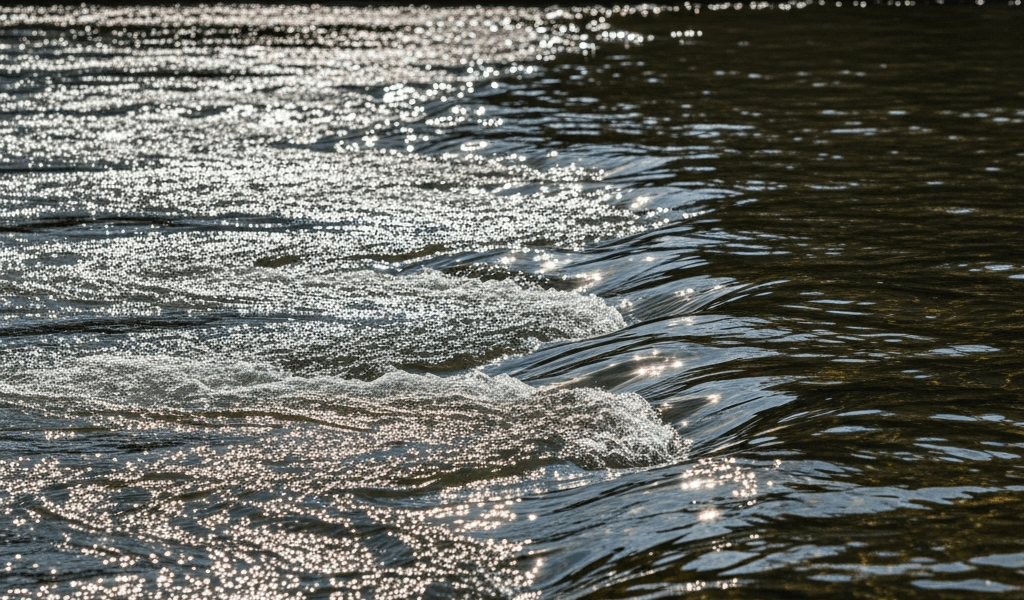
Step back from the water before you do anything else. Look for a color change. Fast water runs lighter, almost white, visibly chaotic on the surface. Slow water sits darker, smoother, sometimes nearly glassy. That junction between them — that’s your seam. Sometimes color doesn’t shift dramatically and you’re reading texture instead. Fast water looks broken and rippled. Slow water just… sits there.
Baitfish get absolutely disoriented at these current junctions. They can’t hold their orientation. They tumble. They panic. Predators know this and post up on the slow side of the seam, ready to dart into the fast water, snatch something confused, and pull back without burning much energy at all.
Don’t make my mistake. I spent an entire spring — probably thirty hours of fishing, honestly — casting perpendicular to seams instead of parallel. Caught almost nothing. The moment I started casting upstream and stripping parallel to that color line, letting the lure ride the seam itself, bass showed up immediately. Walleye too. The speed of the pattern once I understood it was almost embarrassing.
That’s what makes seams endearing to us river anglers. They work universally. Bass, trout, pike, walleye — the mechanism doesn’t change species to species. Find them along inside bends, around bridge pilings, below boulders, anywhere current speed transitions noticeably. Nearly every section of fishable river has at least one good one.
Eddies, Bends, and Current Breaks Fish Love to Hide In
Probably should have opened with this section, honestly.
An eddy forms when current collides with an obstacle — a boulder, a piling, a downed tree — and water swirls backward in the downstream shadow. Dead water. Fish stage there because they’re not fighting anything. They sit. They watch. Food drifts in from the main current and they eat it without moving far.
Think of an eddy as a gas station on the highway. Fish pull in, rest, fuel up when something drifts by, then pull back into the current when they’re ready. I’m apparently a slow learner here — I used to pull one fish from an eddy and assume the rest had scattered. Turns out they were just holding deeper, waiting. Fish stack vertically in eddies. One near the surface, one at mid-depth, one hugging the bottom. If nothing’s biting at one depth, go deeper before you abandon the spot.
Outside bends get scoured deep by current. Inside bends stay shallow. But the tail of an inside bend — where sediment settles and the bank flattens out — that’s a staging zone. Trout love inside bend tails. Large bass do too. Worth hitting every time you pass one.
Undercut banks are the sleeper feature most anglers walk right past. The river carves hollow caverns underneath certain bank sections over years of flow. Big trout and big bass use these as ambush points. A 7-weight fly rod or a medium-heavy spinning setup — something around a 7-foot, medium-heavy Ugly Stik or similar — lets you cast up under those overhangs and strip back downstream. Difficult presentation. Trophy fish. Worth learning.
Water Depth Cues You Can Spot Without a Sonar
You don’t need electronics. Your eyes tell you everything.
Dark green or near-black water is deep. Light tan, sandy, or pale blue-green means shallow. Light hits shallow water, reflects back at you, and the bottom shows. Deep water absorbs it. Train your eye on this and you can estimate depth within a foot just by reading color. It takes maybe one afternoon to click.
The riffle-run-pool sequence matters too. Riffles are shallow, fast, choppy. Below every riffle sits a run — deeper, slower, darker. Below every run eventually comes a pool — deepest, slowest, darkest. Fish hunt briefly in riffles. They live in runs. They stage in pools. The transition from riffle tail into the top of a run is productive almost every single time.
Smooth, laminar surface flow almost always means depth underneath. Chop and white water means rocks, shallows, and energy expenditure. Deep pools develop that almost glassy surface even when current moves steadily through them. That calm look isn’t calm — it’s just deep.
I’m apparently a polarized sunglasses person and Costa Del Mar Fantail 580P lenses — around $220 retail — work for me while standard sunglasses never really cut the glare adequately. Not required gear for reading a river, but they accelerate everything. You can see bottom structure, fish shadows, and depth changes with a clarity that’s genuinely startling the first time.
Put It Together — A 5-Minute River Read Before Your First Cast
When you arrive, don’t cast immediately. So, without further ado, let’s dive into the actual five-minute read.
First, identify seams. Look for color and texture transitions. Mark the clearest ones mentally — those are your primary targets. Second, find the biggest current breaks. Boulders, pilings, anything that interrupts flow. Fish hold immediately downstream and to the side of these. Third, locate one deep pool. Usually the darkest, calmest section — the place water seems to collect and settle. Start there if you want a confidence fish. Fourth, note any water entering differently. Tributary mouths, small drainages, even a spring seep along the bank. Fish pile up at confluences.
That’s it. Four steps. Five minutes. No sonar required, no years of experience required, no expensive gear required beyond polarized lenses if you want them.
Frustrated by years of casting hopefully into fast, empty current, most anglers eventually stumble onto this framework using nothing more than their own eyes and some deliberate observation. This new approach takes hold after just a few sessions and eventually evolves into the intuitive river-reading skill that experienced anglers know and rely on today.
After those five minutes, you fish with certainty instead of hope. You hit seams deliberately. You work eddies systematically. You skip the dramatic-looking fast water entirely. Catch rates climb — not gradually, but fast — because you’re finally standing in front of the water and actually seeing it.

Stay in the loop
Get the latest freshwater fishing spots updates delivered to your inbox.