The Bite Died — Here Is What Probably Happened
Fishing has gotten complicated with all the bad advice flying around. But here’s the truth I had to learn myself: fish don’t randomly stop biting. Something changed. I was on Dale Hollow Lake one June morning — a Tuesday, around 6:45 a.m. — pulling smallmouth off a seawall every five minutes with a Rapala X-Rap 10. Then, inside thirty minutes, nothing. I kept throwing the same lure at the same concrete. Convinced myself the fish had moved on. They hadn’t. I just couldn’t see what had changed.
As someone who has blanked enough water to fill a small lake with regret, I learned everything there is to know about diagnosing a dead bite. Today, I will share it all with you. Four things explain almost every mid-session shutdown: pressure shifts, time-of-day movements, presentation drift, and your own behavior tipping off the fish. Let’s get into each one — with actual fixes, not vague suggestions to “try a different lure.”
Weather and Pressure Shifts That Kill the Bite
But what is a barometric pressure crash, really? In essence, it’s a rapid drop in atmospheric pressure — sometimes 0.10 inches in under two hours — that disrupts how fish feel physically. But it’s much more than that. Fish have swim bladders, gas-filled organs that regulate depth. When pressure tanks fast, those organs feel it. Their lateral lines feel it too. The result isn’t laziness — it’s genuine discomfort. They stop feeding and bury into heavy cover or drop to the bottom of the deepest holes you can find.
A cold front moving through is the worst-case version of this. Post-front recovery takes 24 to 48 hours in most conditions. If you’re caught in the middle of the crash, the answer isn’t to leave — it’s to completely slow down. Drop from a 6-inch crankbait burned at a 4-foot retrieve pace to a 3-inch finesse worm dragged across bottom structure. Target the deepest available water. Not the shallow transition zones where you were catching them an hour ago.
Rising pressure works differently. After a low-pressure system clears and pressure climbs, fish often go on a short feeding tear — 4 to 6 hours of aggression before they settle again. This is the window to cover water fast. Topwater. Shallow-diving crankbaits. Move constantly. Deep structure can wait.
Wind direction gets overlooked constantly, and I made that mistake for years. A south-to-north wind shift usually means rising pressure and dropping water temperature. Fish that were cruising a sunny southern bank at 8 a.m. migrate toward deeper water or shaded structure by 10. The fix isn’t complicated — flip your target zone. Leave the south-facing bank. Work the north side. Go from shallow to mid-depth structure. The fish didn’t vanish. They just moved.
Cloud transitions matter more than most anglers give them credit for. Heavy overcast moving in can trigger a 20-to-40-minute window of aggressive feeding as light levels drop fast. Clear skies emerging mid-morning? That can shut down shallow water entirely. Fish push deeper, find shadow lines under bridge pilings, stack against downed timber. Don’t keep throwing at open flats when the sky clears. That’s a losing battle.
Time of Day Mistakes Most Anglers Overlook
Probably should have opened with this section, honestly. The summer midday dead zone isn’t a myth — it’s a biological reality. Bass metabolism tracks water temperature. Once the surface climbs past 78 degrees, the early morning feeding window collapses by 10 a.m. and doesn’t reopen until around 5 p.m. Grinding through 11 a.m. to 4 p.m. in July on shallow water is a slow punishment most anglers keep inflicting on themselves.
Warmer water holds less dissolved oxygen. Fish conserve energy in peak heat and drift toward deeper, thermally stable zones — channel drops, deep ledges, submerged timber. They’re not gone. They’re just not where they were at sunrise, and they’re not interested in burning calories chasing something fast-moving.
The fix isn’t driving to a new lake. It’s moving to 15-to-25-foot water and slowing everything down. Drop-shot rigs. Shaky heads. A spinnerbait slow-rolled at 1 mph instead of 3. That’s the midday adjustment — depth and speed, nothing exotic.
Solunar periods add another layer most anglers ignore. These are daily feeding windows tied to moon phase and sun position. I’m apparently more sensitive to solunar timing than I realized — the Solunar Time app works for me while ignoring it never does on tough midday sessions. Even a minor feeding window at 2 p.m. can produce 30 to 60 minutes of concentrated bites when everything else feels dead. Download the app. It’s free. Fish the windows before you pack up.
Species also matter here. Catfish feed at night almost exclusively during summer. Don’t make my mistake — don’t grind catfish holes at noon expecting results. Shift to bass or crappie during the day. Come back to catfish structure at sunset with live bluegill, maybe some chicken liver on a secondary rod.
Presentation Problems That Shut Fish Down
Line visibility in clear water is probably the most under-discussed bite killer there is. Six-pound-test monofilament is visible to bass in under 8 feet of water on a clear day. I know that sounds paranoid. It isn’t. Drop to 4-pound-test fluorocarbon or run 6-pound braid with a 2-foot fluorocarbon leader. A new spool runs about $15 at most tackle shops. The bite recovery can be almost immediate — that’s how much line matters in clear, shallow conditions.
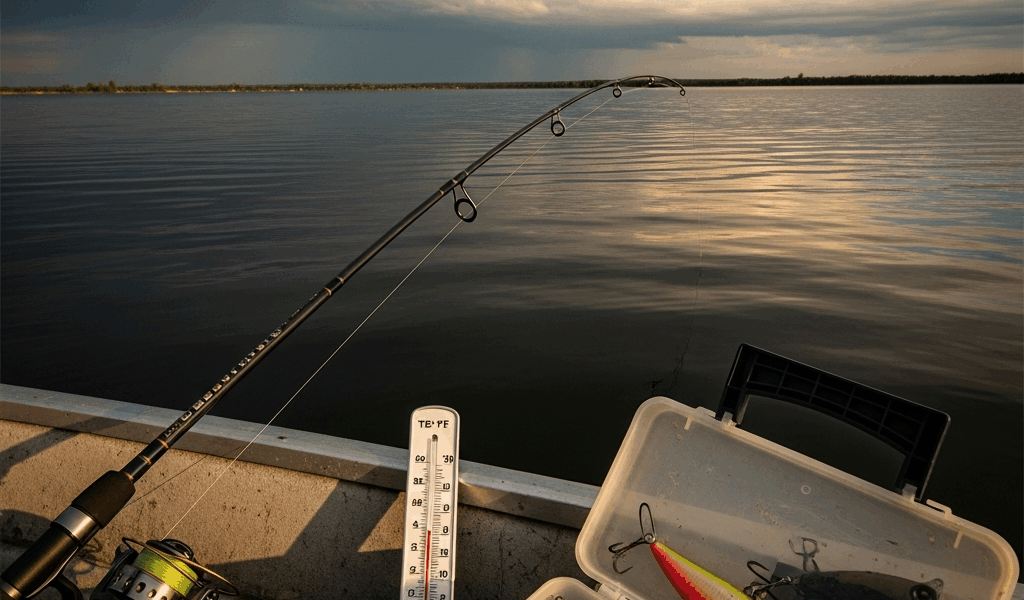
Retrieve speed is something fishing content almost never addresses precisely enough. Cold water — below 50 degrees — requires slow retrieves. Five to 10 cranks per minute, sometimes less. Warm water above 70 degrees can handle 20 to 30 cranks per minute without spooking fish. At 62 degrees, you’re somewhere in between. Most anglers fish one speed in all conditions and assume the fish just aren’t there. Check water temperature with a basic thermometer — the cheap clip-on versions work fine — and match your retrieve speed to the actual conditions. That single adjustment has recovered more bites for me than any lure change.
Over-fishing a single spot creates a slow-building problem that’s easy to miss. Cast the same rock pile or eddy 20 times in an hour and the fish left in that zone pattern your lure as fake. The fix: two or three casts per spot maximum, then move 20 feet. That’s it. You’ll connect more fish on the first cast to a fresh location than on the 18th cast to the same stump.
Noise in shallow water is real and underestimated. Dropped tackle boxes, heavy footsteps on aluminum, drag settings that scream during a retrieve — all of it registers in water under 6 feet deep. I’m apparently the loud type — I cleared a flat on the Shenandoah River once with my Shimano Curado K cranked to full drag tension during a fast strip. The sound alone shut the zone down. Soft casts, dialed-back drag, quiet movement. Stealth in shallow water beats distance every time.
Quick Checklist Before You Move to a New Spot
Before you fire up the motor and head somewhere else, run through this. It takes three minutes and has saved more sessions than I can count.
- Check barometric pressure — has it moved more than 0.05 inches in the last two hours? If yes, drop your depth and slow your retrieve before anything else.
- Assess water temperature against your retrieve speed. Are they matched? A $12 thermometer tells you everything.
- Look at your line. Clear water under 8 feet means you probably need to drop to 4-pound fluorocarbon — at least if you want a real shot at fish that have already seen your presentation.
- Pull up solunar timing. Are you between windows? If yes, the next minor window might be 45 minutes away. That’s worth waiting out.
- Check the time and season. Midday summer dead zone active? Switch to deep structure or target a different species entirely.
- Count your casts to that spot. More than three? Move 20 feet. Start fresh.
- Post-front window. Cold front passed in the last 12 hours? That’s not a fixed problem — you may need another 12 to 36 hours before that water produces again.
- Wind and sky check. Did cloud cover change or wind direction shift? That’s your cue to flip zones before abandoning the water entirely.
Diagnosing why the bite died is almost always faster than trailering the boat to new water. Most shutdowns come down to one variable — depth, retrieve speed, line weight, or timing. I’ve recovered more fish by staying put and working through the checklist than I ever have by burning gas to relocate. That’s what makes systematic troubleshooting endearing to us anglers who’d rather catch fish than drive around looking for them. The fish are there. You’re just presenting to them in the wrong way.


Stay in the loop
Get the latest freshwater fishing spots updates delivered to your inbox.