The Technology Battle Under the Water
Walk into any fishing gear store these days and you’ll find fish finders ranging from $50 budget models to $3,000 professional units. The marketing materials throw around terms like “CHIRP sonar,” “down imaging,” “side scan,” and increasingly, references to LiDAR technology. It’s enough to make your head spin.
But here’s what actually matters: understanding which technology works best for the kind of fishing you do. And that starts with understanding how these systems actually detect fish and structure beneath your boat.

How Sonar Actually Works
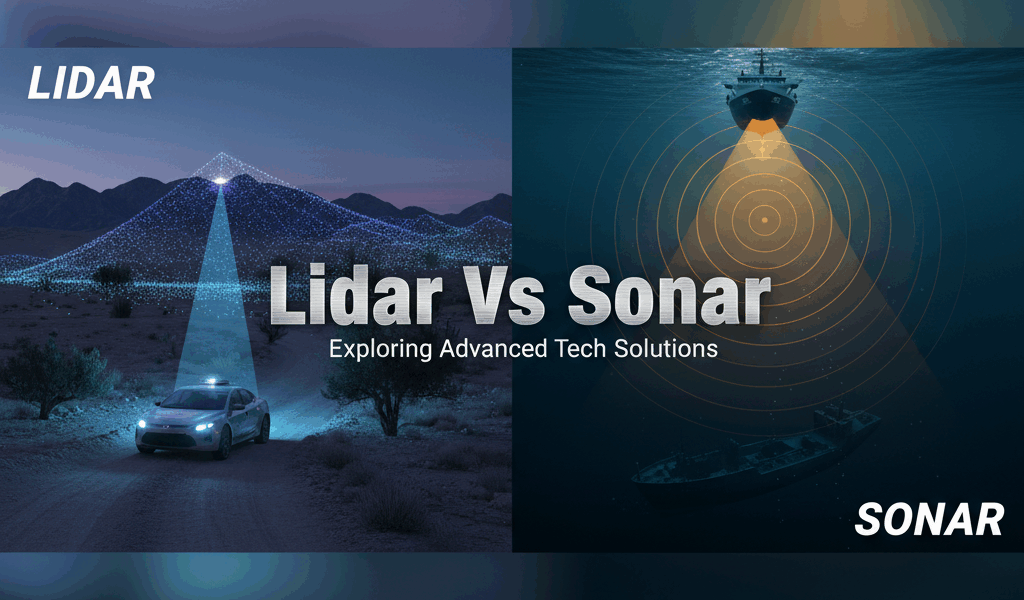
Sonar—Sound Navigation and Ranging—has been the backbone of underwater detection since World War II. The basic principle is elegantly simple: send a sound pulse into the water, wait for it to bounce off something, measure how long that takes.
Modern fish finders take this concept and refine it considerably. They typically operate at frequencies between 50 and 200 kHz, with some units pushing even higher. Lower frequencies penetrate deeper but show less detail. Higher frequencies give you crisp images but peter out in deeper water.
The real magic happens in how these units interpret the returning echoes. A hard bottom reads differently than a soft muddy one. A school of baitfish creates a distinctive cloud pattern. A solitary bass holding near structure appears as a distinct arch as it moves through your sonar cone.
Types of Sonar You’ll Encounter
Traditional 2D sonar paints a picture of what’s directly beneath your boat. It’s been refined over decades and remains remarkably effective for most fishing applications. If your grandfather used a fish finder, this is the technology he knew.
Down imaging and side imaging represent the next evolution. These systems use narrow, high-frequency beams to create almost photographic views of the bottom. You can literally see stumps, brush piles, and individual rocks with startling clarity.

360-degree scanning sonar—like Garmin’s LiveScope or Humminbird’s Mega Live—has revolutionized bass fishing in particular. These forward-facing systems let you watch fish react to your lure in real time. It’s almost like cheating, which is why some tournaments have started restricting their use.
Where LiDAR Fits In
LiDAR—Light Detection and Ranging—works on the same basic principle as sonar, but uses light pulses instead of sound waves. In open air, LiDAR is incredibly precise. Self-driving cars use it to map their surroundings with centimeter accuracy.
Underwater, though, LiDAR faces some fundamental challenges.
Light doesn’t travel through water the way sound does. It refracts at the surface, and then gets absorbed as it penetrates deeper. In murky water, LiDAR becomes essentially useless within a few feet. Even in crystal-clear conditions, you’re looking at maybe 30-40 feet of effective range.
This doesn’t mean LiDAR has no place in fishing. Bathymetric LiDAR, mounted on aircraft or drones, is becoming increasingly useful for mapping shallow water structure. Lake maps generated from LiDAR data can show detail that conventional sonar surveys miss.
But for real-time fish detection? Sonar remains king, and it’s not particularly close.
Practical Buying Advice
If you’re in the market for fish-finding electronics, here’s how to think about it:
For kayak and small boat anglers: A good CHIRP sonar unit in the $200-400 range will serve you well. Look for something with GPS built in so you can mark productive spots. Garmin’s Striker series and Lowrance’s Hook Reveal line offer solid performance at reasonable prices.
For serious bass anglers: Consider stepping up to a unit with side imaging and down imaging capabilities. The ability to scan structure as you idle past it changes how you fish. Expect to spend $700-1,500 for a quality unit.
For tournament anglers: Forward-facing live sonar is increasingly becoming standard equipment. These units aren’t cheap—you’re looking at $2,500 and up—but the competitive advantage is real.
The Bottom Line
Don’t get distracted by marketing buzz about emerging technologies. For underwater fish detection, sonar technology has been refined over decades and works remarkably well. The improvements in recent years—CHIRP processing, imaging sonar, live scanning—have all built on this proven foundation.
LiDAR might eventually find its niche in fishing applications, particularly for mapping and structure identification in very clear, shallow water. But for finding fish in real-time? Stick with sonar. It’s not the newest technology, but it’s the right tool for the job.
Spend your money on a quality sonar unit from a reputable manufacturer, learn to read what it’s telling you, and focus on putting yourself in front of fish. The technology is just a tool—you still have to do the fishing.