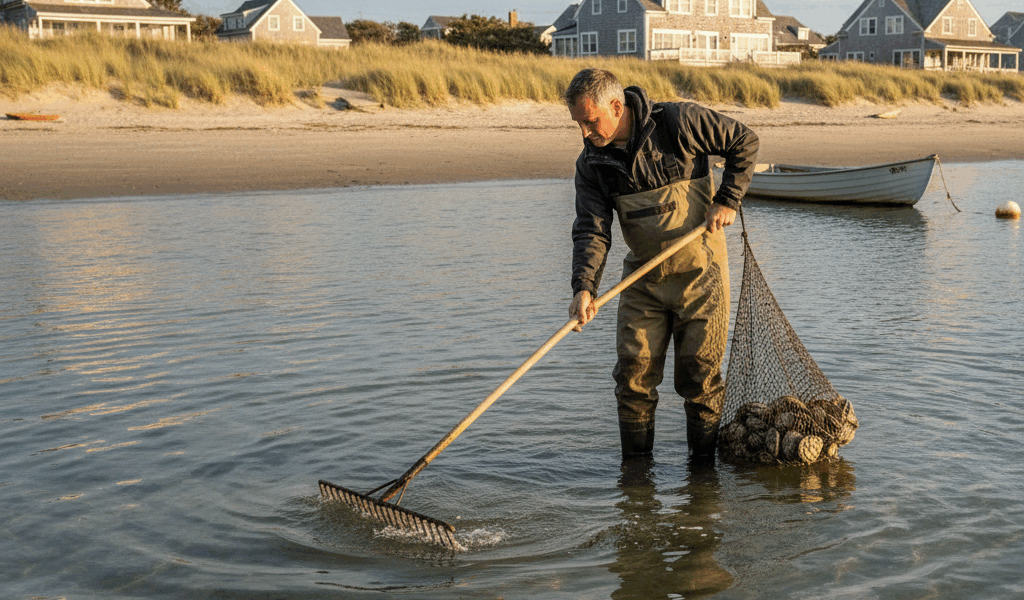
My grandfather took me quahogging for the first time when I was maybe ten years old. We waded into Narragansett Bay with rakes and baskets, and he showed me how to feel for clams in the mud with my feet. I thought it was weird. By the end of the day, I was hooked.
Forty years later, I still go out when the tide is right.
What Quahogging Actually Is
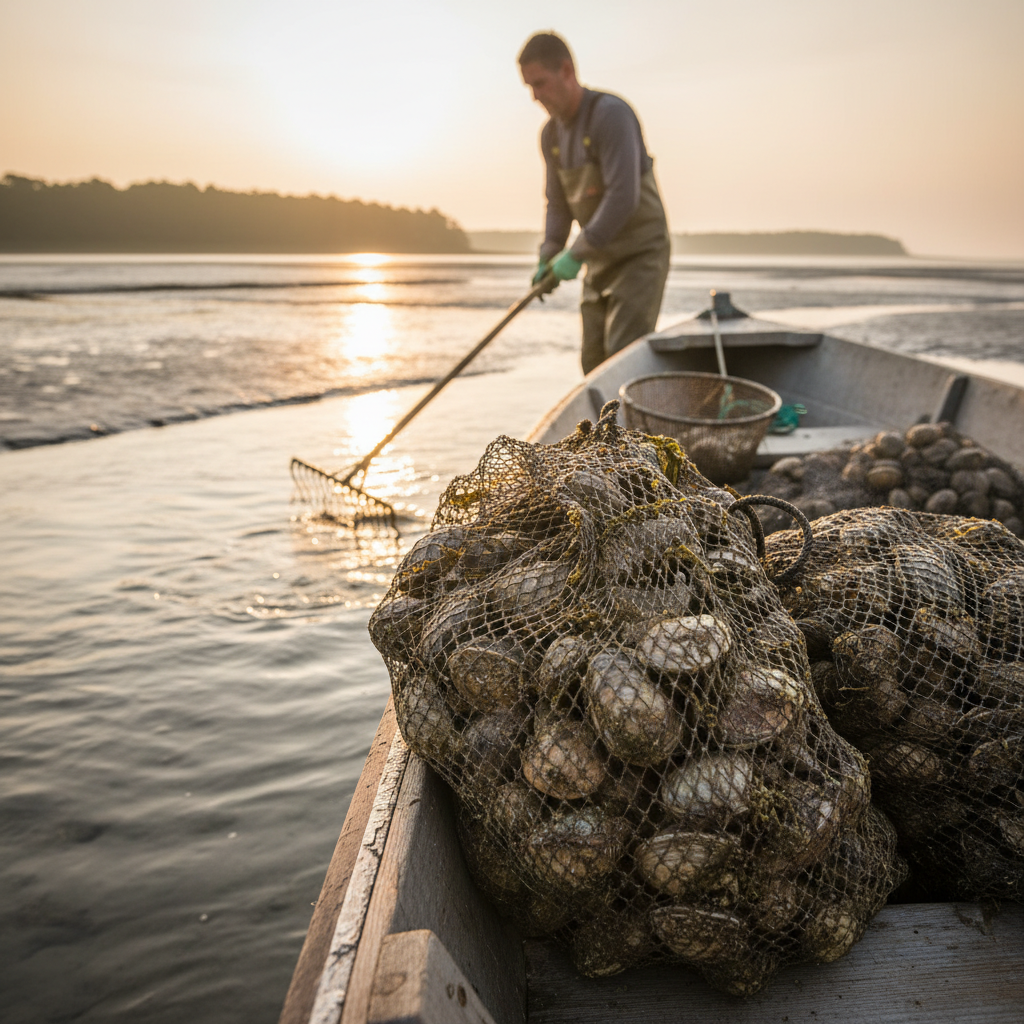
Quahogs are hard-shell clams—the ones you find in clam chowder, stuffed clams, and raw bars. They live buried in sandy or muddy bottoms in shallow coastal waters, mostly from Cape Cod down through New Jersey, though they range further in both directions.
Quahogging is the act of harvesting them. You can do it with a rake, with your feet, or by diving. The method depends on the water depth and your personal preference.
In Rhode Island, where I learned, it’s practically a regional sport. On a good low tide, you’ll see dozens of people working the flats, rakes in hand, buckets floating behind them.
The Equipment
A quahog rake looks like a garden rake had a baby with a basket. Long handle, tines that curve into a cage. You drag it through the bottom and the clams get trapped in the basket while sand and mud fall through.
Good rakes aren’t cheap—maybe $80 to $150 for something that’ll last. Cheap rakes bend or break when you hit a rock. I’m on my third rake in forty years, which tells you how long a good one lasts.
You need waders or old sneakers you don’t mind destroying. A floating basket or mesh bag for your catch. A measuring gauge to check that clams meet the legal minimum size. Sunscreen, water, hat. That’s about it.
Finding the Clams
Quahogs like certain kinds of bottom. Not too muddy, not too sandy. Eelgrass beds often hold good populations. Channels where current flows concentrate nutrients. The edges of sandbars.
Learning to read the bottom takes time. I can look at a flat now and have a pretty good sense of where to start. That knowledge accumulated over decades of trial and error—mostly error, early on.
The foot method works in shallow water. You shuffle slowly, feeling for the hard bump of a clam in the soft bottom. When you feel one, you reach down and grab it. Sounds simple, and it is, but your feet get sensitized over time. Things that fooled me as a kid—rocks, shells—I can distinguish now by feel alone.
The Seasons
You can quahog year-round in most places, but the experience varies dramatically. Summer means warm water and crowds. Winter means solitude and numb feet.
I prefer fall—September through November. The summer people have gone home, the water is still warm enough to be comfortable, and the clams are fat from a summer of feeding. Spring is good too, before the crowds return.
Some people work through winter in wetsuits. I’ve done it a few times. The clams are there, but the suffering is real. Mostly I leave winter quahogging to the professionals who sell their catch.
The Regulations
Every state handles this differently. Rhode Island requires a recreational license—cheap, easy to get. There are daily bag limits, minimum sizes, and closed areas where pollution makes harvesting unsafe.
Take the regulations seriously. The size limits exist because quahogs need to spawn before harvest. The pollution closures exist because eating contaminated shellfish can genuinely sicken you. I’ve seen people ignore both and I don’t understand the thinking.
Check your local regulations before you go. They change, and ignorance isn’t an excuse.
What To Do With Them
Small quahogs—littlenecks and cherrystones—are best raw or barely cooked. On the half shell with lemon and hot sauce. Steamed just until they open. Grilled briefly over high heat.
Large quahogs—what we call chowder clams—are too tough to eat whole. Chop them for chowder, stuff them with breadcrumbs and butter, or grind them for clam cakes. The flavor concentrates in bigger clams; you just have to work around the texture.
My grandmother’s stuffed quahog recipe is probably the single best thing I’ve ever eaten. I make it a few times each fall with clams I’ve harvested myself. The connection between the flat and the table makes the food mean something.
Why It Matters
Quahogging is the kind of thing that could disappear if nobody learns it. The old-timers who taught me are mostly gone now. Fewer young people are picking it up.
But when I’m out on the flat, rake in hand, feeling for clams the way my grandfather showed me, I’m connected to something older than myself. The technique hasn’t changed in generations. The clams don’t care what year it is.
That continuity matters to me. I hope it matters to whoever learns it next.