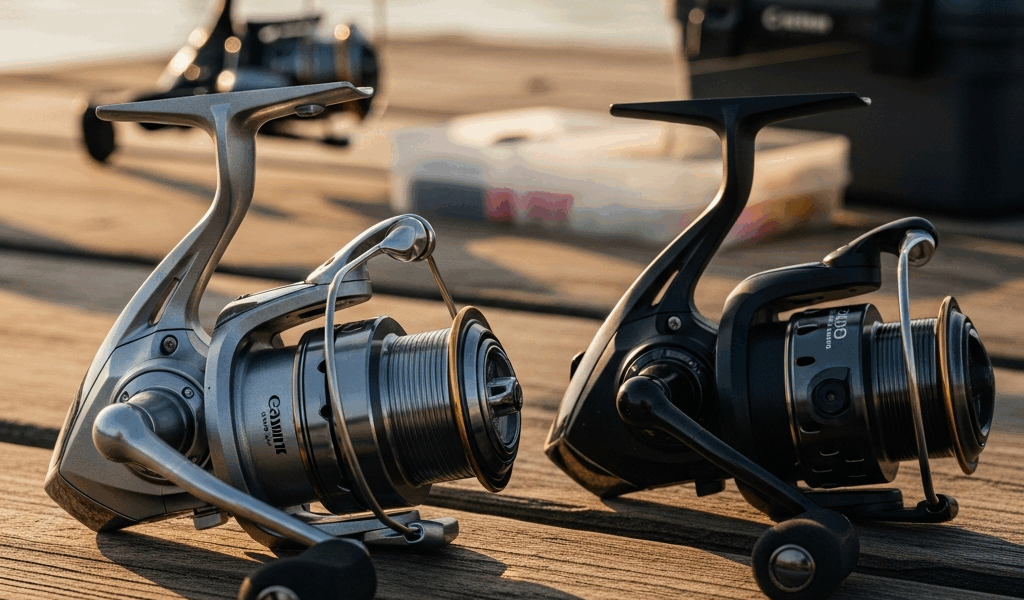
The Quick Answer — Beginners Should Start With Spinning
Picking between a spinning reel vs baitcaster has gotten complicated with all the YouTube gear wars and forum arguments flying around. As someone who’s dragged probably forty or fifty people out to the water over the years — kids, retirees, a few folks who’d never touched a fishing rod in their lives — I learned everything there is to know about which reel actually works for beginners. Today, I will share it all with you.
Buy a spinning reel first. Full stop. The people I know who handed a baitcaster to a first-timer? That beginner got frustrated, got tangled, and half of them never came back for a second trip. I watched it happen more than once.
That’s not a knock on baitcasters. They’re excellent tools. But handing one to a beginner is like teaching someone to drive on a steep hill in traffic — in a manual transmission car. Technically possible. Not advisable. Spinning reels have almost no learning curve. Open the bail, cast, close the bail, reel in. A first-timer can make a fishable cast within ten or fifteen minutes. Baitcasters demand feel for spool tension, thumb pressure, and braking system all at once — or you end up with a bird’s nest of line that eats twenty minutes of your afternoon. I’ve watched grown adults nearly cry over a backlash tangle. Learn on a spinning reel. Graduate later.
This article includes affiliate links. We may earn a commission at no extra cost to you.
What a Spinning Reel Does Better
Probably should have opened with this section, honestly — because once you understand why spinning reels are better for beginners, the whole decision gets obvious. So, without further ado, let’s dive in.
No Backlash
Backlash is the bane of every baitcaster beginner. The spool spins faster than the line leaves it — the result is a tangled mess of monofilament or braid that can genuinely ruin an afternoon. Spinning reels don’t backlash. The spool is fixed. Line peels off the end during the cast, which means there’s no spool rotation to manage. You just cast. That single fact alone is why I recommend spinning gear to every beginner without exception.
Works With Light Lures
A lot of beginner fishing involves lighter presentations — small jigs, live bait under a bobber, 1/8 oz spinners. Baitcasters genuinely struggle with anything under about 3/8 oz. The lure doesn’t have enough weight to pull line off the spool cleanly, and that only makes backlash more likely. Spinning reels handle light lures beautifully. I regularly throw a 1/16 oz jig head on a spinning rod without a single issue.
Easier Casting Mechanics
Hook the line with your index finger, open the bail, cast, release. That’s the entire motion on a spinning reel. No brakes to pre-set. No thumb feathering the spool. No weeks of coordination practice before it starts feeling natural. A first-timer can make a reasonably accurate cast on their second or third attempt. That matters enormously when you’re trying to keep someone engaged and actually excited about learning to fish.
Less Maintenance and Setup Complexity
Spinning reels are simpler to maintain — full stop. A decent beginner combo like the Ugly Stik GX2 combo runs around $40 to $50 as a package. Rinse it after saltwater use, keep the bail arm clean, occasionally oil the line roller and handle knob. That’s about it. Baitcasters need bearing maintenance, brake adjustments, and regular cleaning of the spool assembly. Nothing wrong with that once you know what you’re doing. It’s just one more thing a beginner absolutely doesn’t need to be thinking about.
What a Baitcaster Does Better
None of this means baitcasters are inferior. They’re not. They’re the dominant tool among experienced bass anglers, tournament fishermen, and anyone throwing heavy lures at specific targets all day. There are real reasons the professionals use them.
Accuracy
Frustrated by missed targets and close-but-not-close-enough casts, I eventually put in the time to actually learn a baitcaster properly — using a beat-up Abu Garcia Ambassadeur I borrowed from a friend, sitting in my backyard for about three evenings straight. The accuracy improvement was immediate. With a baitcaster, your thumb controls the spool mid-cast, giving you precise say over exactly where and when the lure lands. Once that thumb control becomes instinct, you can drop a lure within inches of a dock piling or a laydown log from thirty feet out. Spinning reels are accurate. Not at that level — not even close.
Handles Heavy Lures and Line
Baitcasters shine with heavier setups. Flipping a 1 oz tungsten weight into thick cover, throwing a 3/4 oz swimbait, punching mats with a heavy Texas rig — spinning gear can manage some of this, but baitcasters are built for it. The gear ratios, line capacity, and mechanical leverage all work together more efficiently once the lures get heavy and the fish get serious.
Power for Big Fish
The drag systems on quality baitcasters — a Shimano Curado DC 150 or an Abu Garcia Revo Beast 41, for example — are positioned to give the angler more direct pulling power against a big fish. Fighting a six-pound largemouth running hard for the weed line, that mechanical advantage is real. Spinning reels have solid drag systems too. For raw power fishing in heavy cover, though, the baitcaster wins that argument.
Line Twist
Here’s one that doesn’t get talked about enough. Spinning reels cause line twist over time — especially with monofilament. The line comes off the spool in a coil and gradually develops memory and twist. Baitcasters don’t do this. Line spools on and off cleanly. If you’re fishing hard and often, this is a meaningful quality-of-life difference that adds up across a full season.
When to Graduate to a Baitcaster
The honest answer — after about six to twelve months of regular fishing. Not calendar months sitting on your shelf. Actual time on the water. Fishing once a week? You’re probably ready to try a baitcaster after your first full season. Fishing twice a month? Give it closer to a year before making the switch.
What you’re waiting for isn’t just time, either. You’re waiting for certain things to feel automatic. Can you cast a spinning rod accurately to a target? Do you understand how different lure weights change your presentation? Can you tell the difference between a strike and a snag? Are you comfortable spooling line, tying a Palomar knot or an improved clinch without looking it up, and swapping out lures without getting flustered? When all of that feels easy — not good, easy — you’re ready.
How to Make the Transition
A magnetic braking system might be the best option, as baitcaster learning requires forgiveness and adjustability on the fly. That is because magnetic brakes let you dial things in quickly mid-session without cracking the sideplate and fumbling with tiny centrifugal shoes. The Daiwa Tatula 150 runs around $100 to $120 and has an excellent braking system for people getting acquainted with the platform. Pair it with a medium-heavy rod, spool it with 15 or 17-pound fluorocarbon, and start throwing lures in the 3/8 to 5/8 oz range. That’s the sweet spot.
While you won’t need a professional casting coach, you will need a handful of open afternoons in the backyard before you ever hit the water. Twenty minutes of field casting teaches more about thumb control than two hours of on-the-water frustration. I’m apparently a slow learner in this department, and my first baitcaster session at the lake never worked for me while the backyard practice always did. Don’t make my mistake.
You Don’t Have to Abandon Your Spinning Rod
Most experienced anglers run both. I carry two or three spinning setups and one or two baitcasters on any given trip — spinning rods for finesse work, light lures, and live bait, baitcasters for heavier presentations and accuracy casting to structure. They serve different purposes. One doesn’t replace the other. Plenty of serious anglers fish spinning gear almost exclusively and never once feel limited by it.
That’s what makes spinning reels so endearing to us beginners — they meet you exactly where you are. The goal when you’re starting out isn’t to eventually use whatever the pros throw on television. The goal is to catch fish, enjoy your time on the water, and build skills that compound over years of practice. A spinning reel gets you there faster, with less frustration, and with more fish in the net while you’re still learning. That’s the whole case right there.



Stay in the loop
Get the latest freshwater fishing spots updates delivered to your inbox.