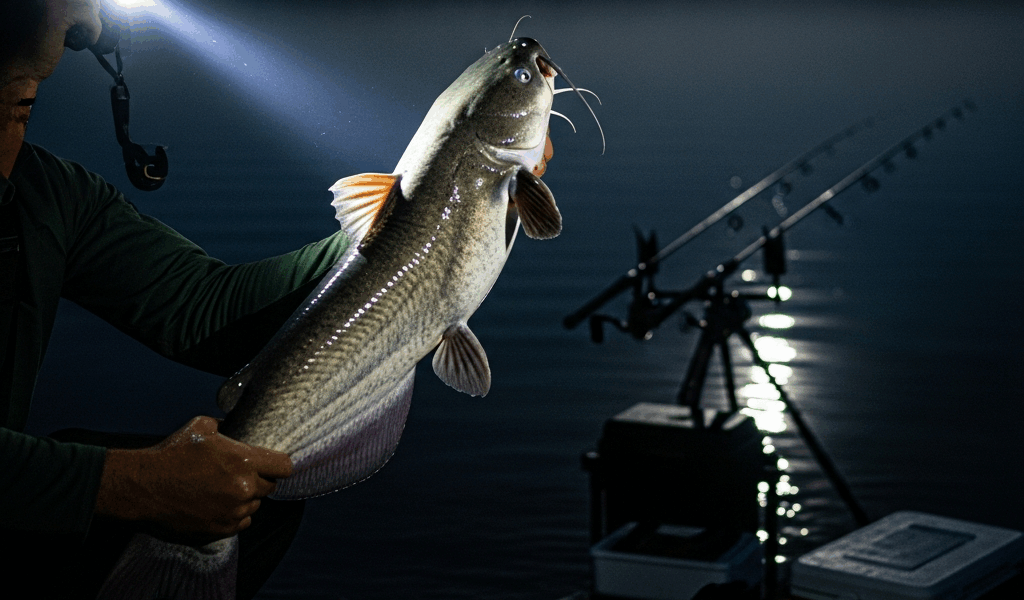
You do not need a boat, a fish finder, or expensive gear to catch catfish at night. A rod, some fresh bait, a lawn chair, and the right spot on the bank produce more catfish than most boat anglers catch in a season. Shore fishing for catfish at night works because catfish move shallow to feed after dark — and you are already positioned exactly where they are heading.
Where to Set Up on the Bank
Catfish travel predictable routes between deep daytime holding areas and shallow nighttime feeding zones. The ideal bank position puts you where those routes cross accessible water.
Points where creek channels swing close to shore — catfish follow the channel edge like a highway and move up onto adjacent flats to feed. Dam tailwaters — current concentrates food, catfish stack below dams at night. Rip-rap banks — the rocks attract crayfish and baitfish, which attract catfish. Feeder creek mouths — runoff carries food into the main body, and catfish patrol these confluences heavily after dark.
Avoid sandy, featureless shoreline with gradual drop-offs. Catfish want structure and depth transitions. A bank with rocks, submerged wood, or a nearby channel drop gives you multiple attractions in one spot.
The Shore Fishing Setup
Medium-heavy rod, 7 to 8 feet, with a baitcasting or heavy spinning reel spooled with 15 to 20 pound monofilament. A slip-sinker rig is the standard: thread a 1 to 3 ounce egg sinker on the main line, tie a barrel swivel, then 18 inches of leader to a circle hook (3/0 to 6/0 depending on target size). The slip-sinker lets catfish pick up the bait and move without feeling resistance from the weight.
Circle hooks are worth emphasizing. They set themselves as the fish moves away — no hard hookset required. When your rod tip loads and line starts peeling, just reel tight and the hook rotates into the corner of the mouth. Circle hooks also reduce gut-hooking dramatically, which matters for catch and release.
Set two or three rods at different distances from shore — one at 20 feet, one at 40, one at 60. Catfish move at different depths through the night and you want bait in all of them. Prop rods in rod holders or forked sticks, tighten the drag just enough to prevent free-spool, and clip a small bell to the rod tip. When it rings, you have a fish.
Bait That Catches Catfish at Night
Fresh cut shad or skipjack: The top producer for channel cats and blue catfish across most of the United States. Cut into chunks that stay on the hook — about 1 to 2 inch pieces with the skin on. The blood and oil disperse in the current and pull catfish from downstream. Fresh matters: bait cut that afternoon outfishes frozen bait every single time.
Live bluegill or shad: Hook through the back behind the dorsal fin. The live bait sends distress signals through the water that flathead catfish cannot ignore. Flatheads strongly prefer live bait over cut or prepared baits — if flatheads are your target, live bait is not optional.
Chicken liver: Cheap, effective, and available at any grocery store. Thread it on a treble hook wrapped with a small piece of mesh (old pantyhose works) to keep it from flying off on the cast. Chicken liver catches channel catfish reliably, smells terrible, and gets the job done when you did not have time to catch fresh bait.
The Night Timeline: When Catfish Feed Hardest
The first hour after sunset is transition time — catfish are moving from deep holes toward shallow feeding areas. Bites are scattered. The peak feeding window runs from about 9 PM to midnight in most fisheries. This is when catfish have reached their feeding stations and are actively eating. Action often slows between midnight and 2 AM, then picks up again in the hour before dawn as fish feed one more time before retreating to deep water.
Plan to fish from sunset through midnight for the highest odds. If you can stay all night, the pre-dawn bite is often the second-best window. But if you only have three hours, make them 9 PM to midnight.



Stay in the loop
Get the latest freshwater fishing spots updates delivered to your inbox.